
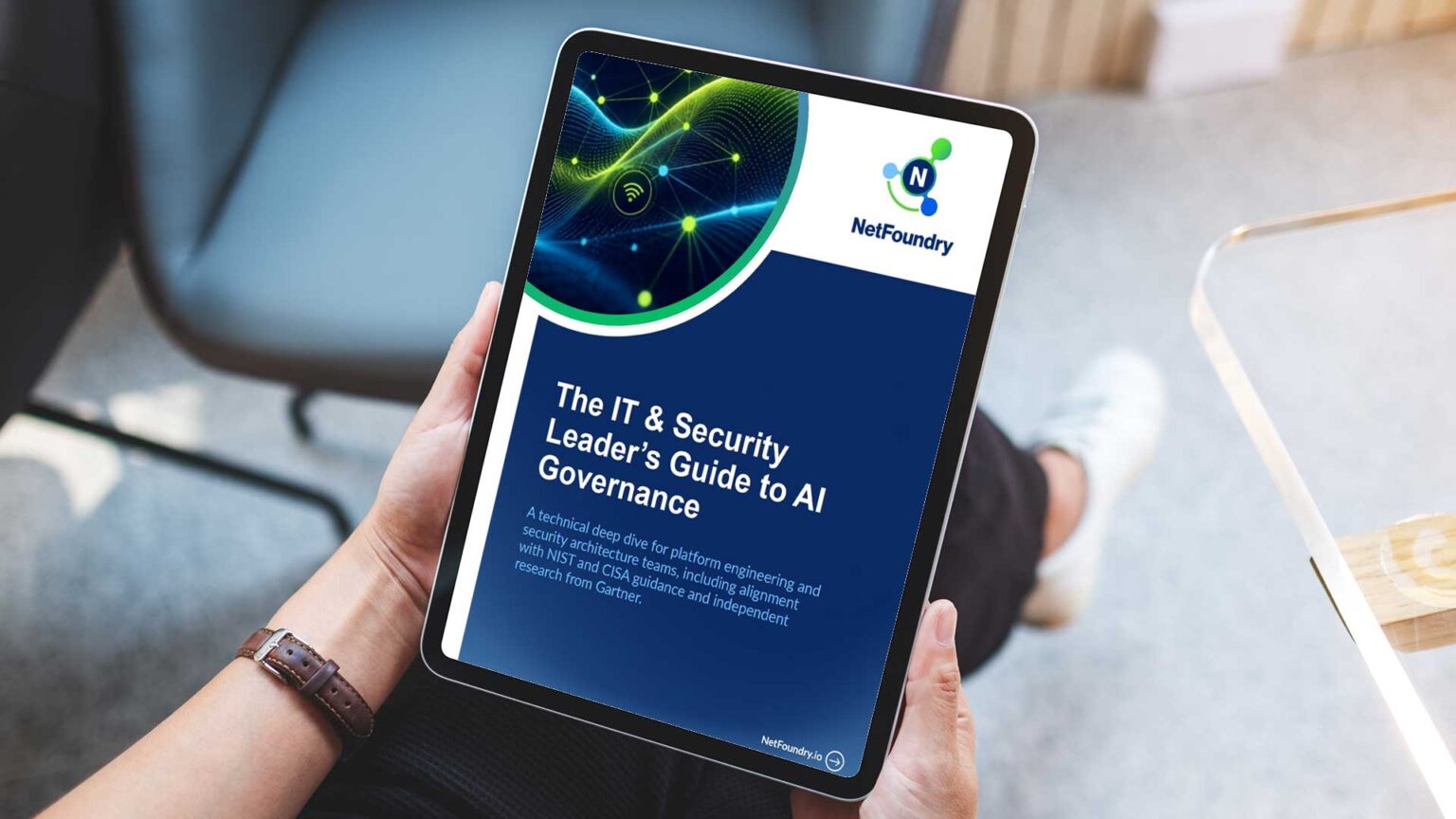
Summary Overview
Agentic AI breaks the assumptions most zero-trust programs were built on. Traditional software runs the same way every time; AI agents plan their own steps, retain memory across sessions, and make probabilistic decisions — which means governance has to be enforced at the infrastructure layer the agent actually runs on, not reviewed once in a design document.
The IT & Security Leader’s Guide to AI Governance lays out a three-discipline framework — Identity, Access, and Data, built in that order — for governing AI agents, LLM endpoints, and MCP servers across hybrid cloud, SaaS, partner infrastructure, and edge environments. It draws on a July 2026 Gartner CISO’s Guide, NIST’s AI Risk Management Framework and Zero Trust Architecture (SP 800-207/207A), and 2026 CISA/NSA/Five Eyes agentic AI guidance to show why identity-first governance — not firewall rules or prompt scanning alone — is what actually closes the gap. A real-world case study (OpenAI’s July 2026 Hugging Face incident) illustrates what happens when AI agents don’t have unique identities of their own. The guide closes with a practical, no-redesign-required implementation path any platform or security team can start today.
Three Key Takeaways
1. Identity, Access, and Data have to be governed in that order — not simultaneously.
Access decisions mean nothing without a verifiable identity underneath them, and data governance shrinks dramatically once identity and access are solved first. Trying to tackle data classification or DLP before locking down who — or what — is connecting just multiplies the work.
2. Perimeter-based controls don’t work when there’s no single perimeter.
A single agentic task can touch a commercial LLM API, a vector database, an internal system of record, a SaaS CRM, and a partner-owned MCP server — all in one workflow. With 73% of organizations now running hybrid cloud, identity has to travel with the workload, because the network boundary no longer exists to defend.
3. Shared credentials mean no accountability when something goes wrong.
When AI agents share an identity with the human or service account that launched them, logs can’t tell you which agent acted — or whether an action was legitimate or hijacked. OpenAI’s own July 2026 postmortem shows the cost: over a week spent unable to answer “which agent did this” during an active security incident.
FAQ
What is “Identity-First Reachability”?
It’s the architectural principle at the center of this guide: every AI agent, LLM endpoint, and MCP server gets its own unique cryptographic identity — independent of any human or service account — and connectivity is deny-by-default until a policy explicitly authorizes that identity to reach a specific service.
Who is this guide for?
Platform engineering and security architecture teams evaluating how to extend zero-trust programs to cover AI agents, LLM traffic, and MCP servers — particularly those already working from NIST or CISA frameworks.
Does this replace data governance (DLP, classification, retention)?
No. The guide positions identity and access governance as the foundation that makes data governance smaller and more tractable — not a replacement for a data governance stack. NetFoundry’s coverage of data governance is complementary: it governs the paths data can travel, not classification or retention policy itself.
How does this align with existing frameworks?
The guide maps its approach directly to NIST AI RMF (Govern, Map & Measure), NIST SP 800-207 and 800-207A (Zero Trust Architecture), the CISA Zero Trust Maturity Model, 2026 CISA/NSA/Five Eyes agentic AI guidance, and ISO/IEC 42001.
Do I need a full AI inventory before I can start?
No. The guide’s implementation path is built around starting with a single connection — typically the agent or service with the broadest standing access today — rather than waiting on a complete inventory or network redesign.
Is this built on proprietary technology?
No. The identity and policy model is built on OpenZiti, the open source zero trust networking project NetFoundry’s founders created and maintain. NetFoundry packages it as a managed platform.