White Paper
NetFoundry flipped the model from “network security” to “secure networking” Business networks (TCP/IP) don’t enforce strong identities, continuous authentication and fine-grained, deny-by-default authorization and access. They are default insecure, default expensive to manage and default blockers to business velocity. The...
Accelerating DTM-25-003 Outcomes with Identity-First, Authenticate-Before-Connect Networking In modern OT, the challenge is no longer just how to connect systems securely, but how to do so without triggering repeated firewall/VLAN changes, MOC cycles, safety reviews, and IT/OT governance friction. This...

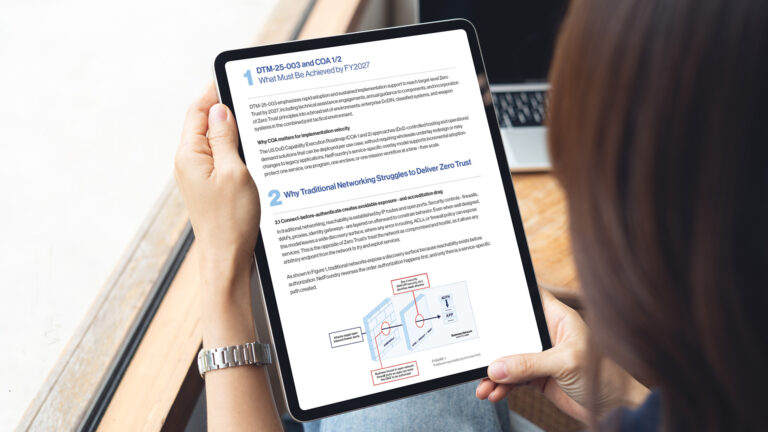
Accelerating DTM-25-003 Outcomes with Identity-First, Authenticate-Before-Connect Networking DoD components are under a clear mandate to achieve, at minimum, target-level Zero Trust across unclassified and classified systems (including national security systems) on the DoDIN by the end of FY2027, with priority...
NIST 800-207 outlines a framework where trust is never granted implicitly based on physical or network location. NIST Special Publication 800-207 is generally considered the most widely respected and authoritative definition of Zero Trust. It fundamentally redefines enterprise security by...
NetFoundry White Papers What Is A Unified Namespace Unified Namespace, or UNS is a concept born primarily of the ANSI_ISA-95 standard’s Equipment Hierarchy Model and extended well beyond it to encompass the entire enterprise. The purpose of UNS is to...