
Zscaler is a strong fit for enterprises that want a cloud-delivered SASE platform. It is not the only answer for zero trust network access in 2026, especially when the requirement is machine-to-machine traffic, private APIs, Kubernetes, or AI agents. The right Zscaler competitor depends on whether you need a security cloud, a direct application path, infrastructure identity, or an embedded zero trust fabric.
This comparison ranks five alternatives by that specific workload and connectivity question. It does not repeat a general human-user ZTNA shortlist. The key test is simple: can the product authenticate a workload before it connects, limit access to a named service, and give your team an audit trail that maps activity to an identity?
What makes a Zscaler alternative credible for workloads?
A credible alternative must protect the workload path, not just the employee session. NIST SP 800-207 defines zero trust around resources and says authentication and authorization happen before a session is established. That matters for agents, services, and APIs because no person is present to complete a login.
Use these criteria when you compare Zscaler competitors:
- Workload identity: Can each agent, service, or device use a cryptographic identity instead of a shared API key or IP allowlist?
- Connection timing: Does policy authorize the request before a routable path exists?
- Traffic model: Does traffic go through a vendor cloud, directly to the resource, or through an embedded overlay?
- Protocol coverage: Can the product handle APIs, TCP services, databases, Kubernetes, and machine-to-machine flows?
- Deployment impact: Does adoption require firewall changes, network redesign, or new routing?
- Audit depth: Can security teams attribute a connection to a workload identity and review the decision later?
- Operating model: Do you need a managed service, a self-hosted option, or both?
The distinction is practical. A workforce ZTNA product can be excellent at replacing remote-access VPNs and still be incomplete for an AI platform that calls internal tools without a human session.
Best Zscaler competitors for machine access
The best option for machine access is NetFoundry when your priority is identity-first reachability across applications, APIs, workloads, and AI agents. Twingate is a strong choice for direct resource access with a simple control plane. Teleport fits infrastructure sessions where ephemeral credentials and command auditing matter most. Cloudflare Access fits teams already invested in Cloudflare’s edge. Tailscale fits engineering teams that want a developer-led mesh.
| Platform | Core model | Best fit for machine access | Main limitation |
|---|---|---|---|
| NetFoundry | Embedded and identity-based overlay | APIs, workloads, AI agents, MCP servers, and private service connectivity | More capability than a team needs for human-only remote access |
| Twingate | Direct-to-resource access with connectors | Resource-level access, cloud networks, and infrastructure automation | Its strongest story remains access management, not a full embedded workload fabric |
| Teleport | Infrastructure identity and privileged access | SSH, Kubernetes, databases, short-lived certificates, and session audit | It governs infrastructure sessions rather than creating a general application overlay |
| Cloudflare Access | Edge-delivered ZTNA and connector model | Mixed user, contractor, private-app, and selected service access | Traffic and policy depend on the Cloudflare platform and plan model |
| Tailscale | WireGuard-based identity mesh | Developer access, subnet routing, and fast infrastructure connectivity | Teams may need more governance and workload-specific controls as deployments grow |
1. NetFoundry: best for identity-first workload reachability
NetFoundry is the strongest Zscaler alternative when the protected subject is a workload rather than a user. Its AI security architecture gives AI agents, LLMs, and MCP servers cryptographic identities, then authorizes policy before a connection exists.
The architecture uses outbound-only connections. Protected services do not need public inbound ports, and the platform can be deployed as a hosted service or through the open-source OpenZiti ecosystem. That makes it relevant for private APIs, multi-cloud services, OT environments, and agent-to-tool communication.
- Workload identities for agents, models, MCP servers, and services
- Service-level least-privilege policy
- End-to-end encrypted connections
- Application-embedded and overlay deployment models
- Central visibility for access decisions and AI interactions
Best for: security and platform teams that need one identity model for human, machine, API, and AI connectivity.
Pricing: NetFoundry does not publish a standard public price on the product pages checked for this comparison. Request pricing from NetFoundry.
Limitation: If your requirement is only browser access for employees and contractors, NetFoundry can be broader than necessary. A focused workforce ZTNA product will be simpler to evaluate.
2. Twingate: best for direct resource access and policy automation
Twingate is a practical Zscaler competitor for teams that want identity-based access to named resources without recutting their network. Its official site documents direct-to-resource connectivity, an API-first design, Terraform and Pulumi integrations, and controls for users and agents.
Twingate is a good middle ground between a large security cloud and an engineering mesh. The product page reports a 90% reduction in deployment time, 99.99% reliability, and 86% faster performance than VPN. Those are vendor-reported figures, so validate them against your own paths and workloads before using them in a business case.
- Connector-based access to cloud and on-premises resources
- Resource-level policy and device controls
- Terraform, Pulumi, and API automation
- Kubernetes access and session visibility
- Identity firewall and just-in-time access features
Best for: platform teams that want a manageable policy layer for private resources and infrastructure, with automation built into deployment.
Pricing: The public page reviewed did not expose a stable plan price. Use Twingate’s pricing page for a current quote or plan detail.
Limitation: Twingate’s center of gravity is access to resources. If you need an embedded identity fabric for software-distributed connectivity or agent-to-tool policy, compare its scope closely with NetFoundry.
3. Teleport: best for infrastructure identity
Teleport is the best Zscaler alternative when the immediate problem is privileged access to SSH, Kubernetes, databases, and internal infrastructure. It replaces long-lived credentials with cryptographic identity and short-lived privileges, and it records infrastructure sessions for review.
Teleport also markets controls for machines, AI, and MCP tooling. That makes it relevant to AI platform teams, but its primary abstraction is still infrastructure access. It decides who can open a session and what that session can do. It is not a universal private connectivity fabric for every application protocol.
- Short-lived certificates and just-in-time privileges
- SSH, Kubernetes, database, and application access
- Session recording and audit trails
- Machine and agent identity features
- Self-hosted and managed deployment choices
Best for: engineering and security teams replacing bastions, static SSH keys, and standing infrastructure privilege.
Pricing: Teleport’s public site directs buyers to its pricing page and sales process. No stable price was stated in the page content checked here.
Limitation: Teleport secures the administrative session. It does not replace every service-to-service overlay, private API path, or application-embedded networking requirement.
4. Cloudflare Access: best for teams already on the Cloudflare edge
Cloudflare Access is a strong fit for organizations that already use Cloudflare and want one edge platform for users, contractors, private applications, and some machine access. It supports identity providers, device posture, clientless browser access, mTLS, service tokens, and connectors that avoid a publicly routable IP.
Cloudflare publishes a free plan, a $7 per user per month pay-as-you-go plan when paid annually, and a custom contract plan on its product page. The free plan is listed for teams under 50 users or enterprise proof-of-concept tests. Confirm current entitlements before procurement because plan limits and add-ons change.
- Clientless access for web applications and browser-based SSH or VNC
- Identity and device-posture policies
- Application connectors and service tokens
- mTLS authentication for device use cases
- Optional integration with the wider Cloudflare One platform
Best for: teams that value fast rollout, broad edge services, and existing Cloudflare operations.
Limitation: Access is part of a larger Cloudflare control plane. Teams seeking a standalone workload fabric or a self-hosted-first model should test the architectural fit rather than judging it only by feature count.
5. Tailscale: best for developer-led connectivity
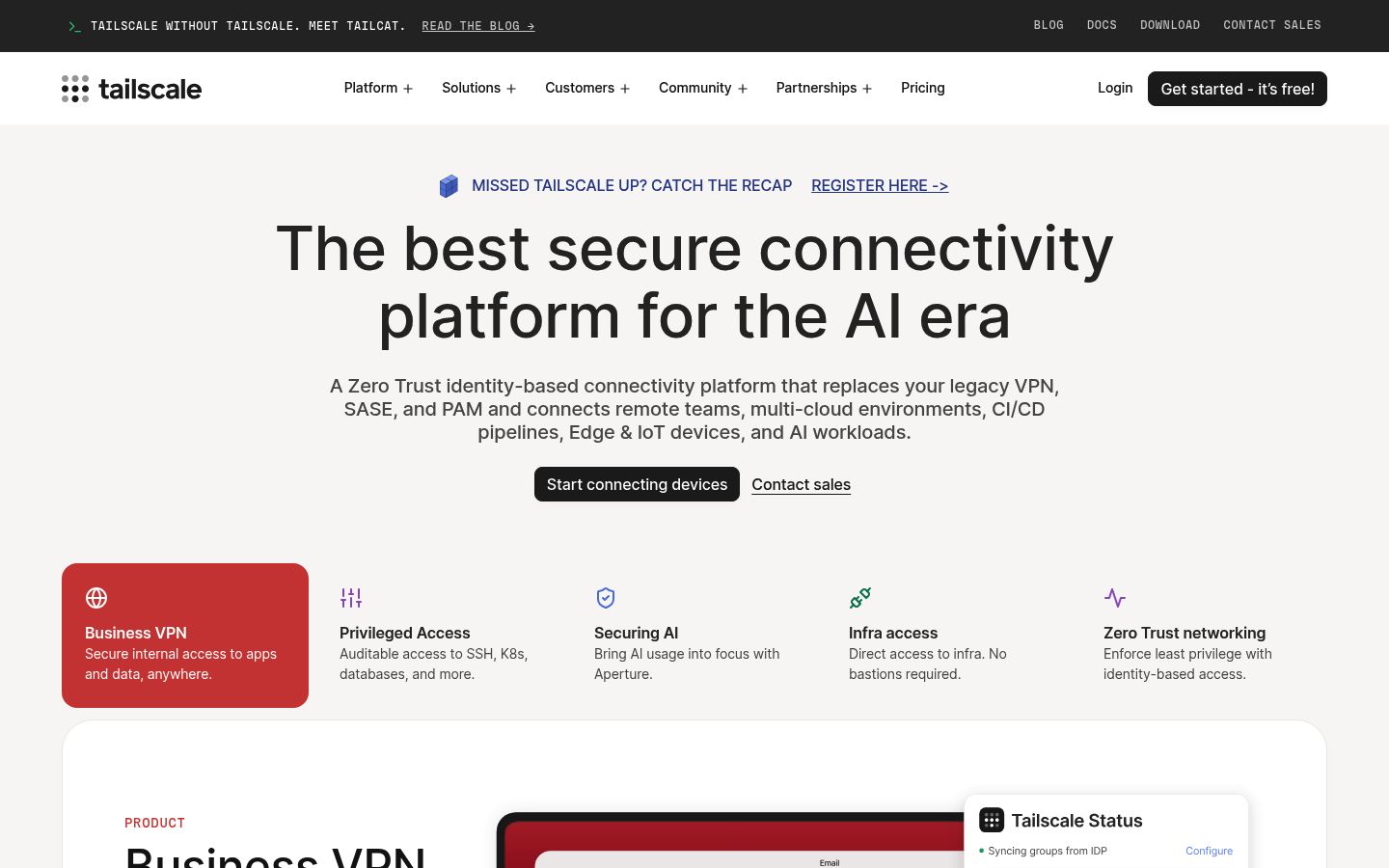
Tailscale is a strong Zscaler competitor for developers connecting laptops, servers, containers, subnet routers, and cloud resources. Its documentation describes an identity-based connectivity platform built around a WireGuard mesh, with access controls, subnet routers, Docker support, automation, and logging.
The direct mesh model is attractive when low operational friction matters. Engineers can reach a specific private resource without placing the whole network behind a traditional VPN. The tradeoff appears when security teams need a uniform policy model for large numbers of machine identities, APIs, embedded applications, or autonomous agents.
- WireGuard-based encrypted mesh connectivity
- Access control policies and identity integration
- Subnet routers and exit nodes
- Docker and automation support
- Developer-friendly deployment and operations
Best for: engineering teams that need quick, low-friction access to infrastructure and private development resources.
Pricing: Tailscale’s public documentation points to account plans, but the page content checked here did not establish a current price. Review Tailscale pricing before comparing total cost.
Limitation: Tailscale is not a complete answer for every enterprise workload or AI-agent policy problem. Test identity lifecycle, audit requirements, service authorization, and relay behavior at your expected scale.
How to choose among Zscaler competitors
Choose the platform by the connection you need to govern, not by the vendor’s category label.
- Choose NetFoundry if agents, APIs, services, and AI workloads must share identity-first policy and private reachability.
- Choose Twingate if you want direct access to named resources with a visual policy layer and infrastructure-as-code support.
- Choose Teleport if the main risk is standing privilege for SSH, Kubernetes, databases, and operator sessions.
- Choose Cloudflare Access if your organization already runs Cloudflare and wants edge-based workforce and private-app access.
- Choose Tailscale if developers need a fast mesh for infrastructure and your governance requirements remain focused.
Keep the layers separate in your design. A platform that authenticates an operator is not automatically the platform that should authorize an AI agent to call a production API. NIST’s zero trust guidance puts the resource at the center, which is the right test for this shortlist.
For teams evaluating AI connections, the existing guide on MCP Gateway Authentication: Workload Identity vs Shared Secrets covers the identity decision in more detail. The MCP Gateway Vendors for Policy-Based Tool Access comparison covers the gateway layer itself.
FAQ
What are the best Zscaler alternatives?
The best Zscaler alternative depends on the access subject. NetFoundry fits machine-to-machine, API, and AI-agent connectivity; Twingate fits direct resource access; Teleport fits infrastructure identity; Cloudflare Access fits edge-based workforce ZTNA; and Tailscale fits developer-led mesh connectivity.
What are the best Zscaler alternatives for AI agents?
NetFoundry is the strongest fit in this comparison when each AI agent, model, and MCP server needs its own cryptographic identity and policy-scoped reachability. Teleport and Twingate are relevant for infrastructure and resource access, but validate whether their controls cover the agent-to-tool paths you need.
Is Cloudflare Access cheaper than Zscaler?
Cloudflare publishes a $0 free plan and a $7 per user per month annual pay-as-you-go plan for Access, while enterprise contracts use custom pricing. Zscaler pricing is generally sales-led, so compare the complete feature set, user count, traffic model, support, and add-ons instead of comparing a public entry price with a quote.
Is Tailscale a Zscaler competitor?
Yes, but the products emphasize different jobs. Tailscale provides developer-friendly identity-based mesh connectivity, while Zscaler provides a broader cloud security platform centered on brokered access and SASE services.
Is Teleport a ZTNA platform?
Teleport provides zero trust infrastructure access with identity, just-in-time privilege, and session auditing. It overlaps with ZTNA for SSH, Kubernetes, databases, and internal applications, but it is not a general replacement for every private service connectivity or workload networking layer.
What should I check before replacing Zscaler?
Test the connection architecture, workload identity, policy evaluation point, protocol coverage, logging, deployment path, and failure behavior. Include at least one API, one Kubernetes service, one machine-to-machine flow, and one AI-agent or MCP flow in the proof of concept.
Related articles
- Enterprise Tailscale Alternatives for ZTNA
- Best Zero-Trust Workload Connectivity Platforms
- Zero Trust Network Access for DevOps Pipelines
- MCP Gateway Authentication: Workload Identity vs Shared Secrets
Sources & References
- NIST Zero Trust Architecture – resource-centric zero trust principles
- CISA Zero Trust Maturity Model – least-privilege and policy guidance
- Cloudflare Access – features and published plan prices
- Twingate – direct access and vendor-reported performance claims
- Teleport – infrastructure identity and ephemeral privilege model
- Tailscale documentation – mesh connectivity and deployment features
- NetFoundry AI Security – workload identity and AI enclave claims