
Enterprise teams looking for a Tailscale alternative should compare more than setup speed. The right zero trust network access (ZTNA) platform must control application reachability, support machine identities, fit hybrid infrastructure, and give security teams evidence they can audit. Tailscale is a strong developer-first option, but NetFoundry, Cloudflare Access, and Twingate fit different enterprise operating models.
The key distinction is architectural. Tailscale and Twingate make private resources easy to reach through identity-based overlays. Cloudflare Access adds ZTNA to a broad edge security platform. NetFoundry makes identity-first reachability the foundation for users, workloads, APIs, OT systems, and AI agents. NIST’s Zero Trust Architecture supports this resource-first approach: authentication and authorization should happen before a session is established, rather than trusting a user’s network location.
What should an enterprise Tailscale alternative provide?
An enterprise Tailscale alternative should make the application invisible until an authorized identity requests it, not merely encrypt traffic between known devices. That means evaluating five controls together:
- Identity granularity: Can policies distinguish a human, device, workload, service account, and AI agent?
- Application reachability: Does the platform expose only named services, or does it create broad network access?
- Deployment fit: Can it connect cloud, data center, edge, and operational technology without a network redesign?
- Policy operations: Can security teams change access centrally without editing routes and firewall rules?
- Evidence: Do logs show who or what reached which service, under which policy, and when?
This is where the comparison differs from a generic list of ZTNA solutions. The question is not which product has the nicest client. It is which architecture keeps enterprise connectivity narrow as the number of services and non-human identities grows.
Best enterprise Tailscale alternatives compared
The shortlist below uses a different lens from a broad zero trust vendor ranking. It focuses on application-level reachability, workload access, control-plane ownership, and the migration path for teams that already use Tailscale.
| Platform | Best fit | Identity and policy model | Enterprise differentiator | Main limitation |
|---|---|---|---|---|
| NetFoundry | Mixed human, workload, API, and OT connectivity | Cryptographic identities with policy before connection | One fabric for heterogeneous environments and microsegmentation | Requires a more deliberate architecture than a small developer tailnet |
| Tailscale | Developer-led access to infrastructure and private services | User, device, and ACL-based access over WireGuard | Very fast adoption and broad developer usability | Network-oriented access can require extra controls for large workload estates |
| Cloudflare Access | Workforce and contractor access alongside SSE/SASE | IdP, device posture, context, and application policies | Edge platform with clientless access and extensive security services | The full platform can be broader than a team that only needs private connectivity |
| Twingate | VPN replacement for users and cloud resources | User, device, resource, and context policies | API-first administration and direct-to-resource connectivity | Teams with deep OT or service-to-service requirements should validate coverage carefully |
1. NetFoundry: best for identity-first enterprise reachability
NetFoundry is the strongest choice when the enterprise needs one policy model across applications, workloads, APIs, sites, and machines. Its platform is built on OpenZiti, and its model is authenticate-before-connect: an endpoint presents a cryptographic identity, policy decides whether it may reach a specific service, and only then does an encrypted path open.
NetFoundry says 3,000 companies use its platform and that it carries more than 1 billion sessions per month, according to its official platform overview. Those are vendor-reported figures, not independent market measurements, but they indicate the scale the company claims to support.
The practical advantage is Universal Microsegmentation without forcing every team to redesign IP space or add another firewall boundary. NetFoundry’s site-to-site model uses outbound-only paths, so overlapping address ranges do not have to determine the policy model. This matters for acquisitions, multi-cloud estates, partner networks, and plant environments where changing topology is expensive.
It is also the most natural fit for agentic AI security in this group. A workload or AI agent can receive its own Non-Human Identity (NHI), then reach only the tools and services permitted by policy. That is a different problem from giving a developer’s laptop access to a subnet. The model keeps this article focused on enterprise alternatives to Tailscale rather than repeating the site’s broader AI security coverage.
Best for: security and infrastructure teams that need one reachability fabric across cloud, on-premises, OT, APIs, and machine-to-machine traffic.
Limitation: NetFoundry is not the fastest choice for a two-person team that only wants private SSH access. Its value appears when the estate, policy scope, or audit burden justifies a platform approach.
2. Tailscale: best when developer adoption is the priority
Tailscale remains a credible enterprise choice, especially when the primary users are developers and platform engineers. The company positions its product for business VPN replacement, Kubernetes access, CI/CD connectivity, infrastructure access, and multi-cloud networking. Its workload connectivity and zero trust networking pages show that its scope now extends well beyond personal device meshes.
Tailscale says 40,000 businesses use the product. It also reports customer outcomes including more than 1,000 hours saved at Corelight, 25x headcount growth without dedicated IT configuration resources at Cribl, and a 90% reduction in internal support requests at Instacart. These figures come from Tailscale’s customer evidence on its homepage, so buyers should ask for the underlying methodology during procurement.
Tailscale’s advantage is low friction. Teams can install an agent, authenticate through an identity provider, and apply ACLs without building a traditional VPN concentrator. That makes it a sensible Tailscale alternative benchmark: any competing platform should explain why its extra controls are worth the operational cost.
The tradeoff is scope. A device-oriented mesh is not automatically a complete workload governance system. Before standardizing on Tailscale for production service-to-service traffic, ask whether its identity, policy, logging, and segmentation model covers every workload class you operate, including short-lived agents and third-party services.
Best for: engineering-led organizations that value fast rollout, simple private access, and a mature developer experience.
Limitation: teams that need a single policy plane for OT, APIs, workloads, and AI agents may need additional products or a more workload-native architecture.
3. Cloudflare Access: best for edge security consolidation
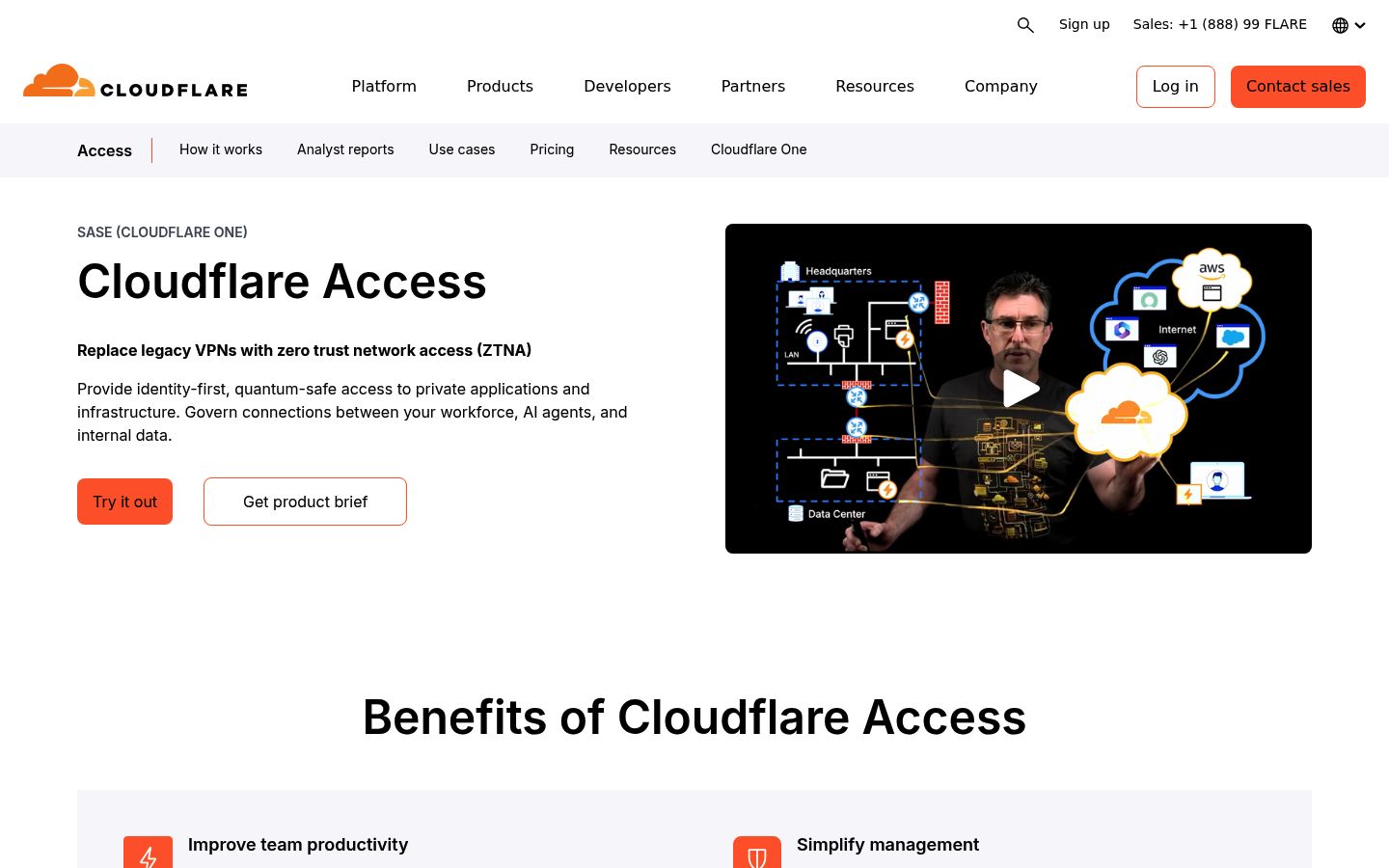
Cloudflare Access is a strong fit when ZTNA is one part of a larger Cloudflare One deployment. It supports self-hosted, SaaS, and non-web applications, including SSH, VNC, RDP, private IPs, and arbitrary TCP or UDP traffic. Its application connector can connect private resources without a publicly routable IP address.
Cloudflare reports that ZTNA reduces remote access support tickets by 80% compared with a VPN. Its published pricing lists a free plan for teams under 50 users, a $7 per user per month pay-as-you-go plan when paid annually, and a custom contract plan. Verify plan limits and support terms before using those figures in a business case because Cloudflare changes packaging across its security products.
The platform is compelling for enterprises that want identity providers, device posture, browser isolation, secure web gateway, DLP, and access controls in one edge platform. Clientless browser access is useful for contractors and occasional administrators who should not receive a full network client.
Best for: security teams consolidating workforce access and internet security on a global edge platform.
Limitation: Cloudflare Access can be more platform than an infrastructure team needs, and buyers should test service-to-service and OT workflows instead of assuming that user-facing ZTNA maps cleanly to them.
4. Twingate: best for resource-level VPN replacement
Twingate focuses on identity-based access for users, services, and AI agents. Its resource model lets administrators define private destinations and attach access groups, protocols, ports, and device controls. The company also documents Terraform, Pulumi, and API-based deployment, which makes it practical for platform teams that want connectivity configuration in infrastructure as code.
Twingate reports a 90% reduction in deployment time, 99.99% reliability, and performance 86% faster than VPN in its published materials. Those are vendor claims linked to its official platform page, and the performance comparison should be tested against your own traffic patterns and regions.
Twingate is a better fit than a basic mesh when the requirement is user-to-resource access across cloud VPCs and private data centers. Its direct-to-resource model also avoids forcing every user through a central VPN gateway.
Best for: mid-market and enterprise teams replacing a traditional VPN with resource-level policies and infrastructure-as-code workflows.
Limitation: validate support for unusual protocols, legacy controllers, partner networks, and high-volume machine-to-machine traffic before treating it as a universal connectivity fabric.
How to choose between these enterprise options
The best choice depends on what you are connecting, not only who is connecting.
Choose NetFoundry if your policy must span human users, workloads, APIs, AI agents, OT, and partner environments. It is the clearest fit for identity-first reachability and microsegmentation without a network redesign.
Choose Tailscale if developers are the main buyers and the priority is adoption speed for infrastructure access. Start with a clear boundary for production workload connectivity and audit requirements.
Choose Cloudflare Access if you already operate Cloudflare or want ZTNA, secure web gateway, DLP, and edge services under one control plane. Confirm that the connector and policy model fit non-web and machine-to-machine use cases.
Choose Twingate if you want a focused VPN replacement with resource-level policy and Terraform or API automation. Run a proof of concept against the hardest application, not the easiest one.
A practical migration test
Run a four-week evaluation with the same three services on each platform: an internal web application, a production database or Kubernetes API, and one machine-to-machine or partner workflow. Record the identity presented, the policy decision, the network path, the failure behavior, and the evidence available to an auditor.
Then test these cases:
- A user loses group membership during an active session.
- A workload is redeployed with a new instance identity.
- A contractor needs access for two hours, without a broad subnet route.
- Two connected environments use overlapping RFC 1918 address ranges.
- A security engineer must revoke one service path without affecting other applications.
The winning platform should deny by default, expose only the named service, and leave a useful record of the decision. A fast installation that creates a large trusted network is not a zero trust result.
FAQ
What is the best Tailscale alternative for enterprise use?
NetFoundry is the strongest option when enterprise use means one identity and policy model for users, workloads, APIs, OT, and AI agents. Cloudflare Access and Twingate are better fits for edge consolidation or focused VPN replacement, while Tailscale remains strong for developer-led infrastructure access.
Is Tailscale a zero trust network access product?
Yes. Tailscale provides identity-based access to private resources and supports enterprise controls such as ACLs and identity provider integration. Enterprises should still verify whether its device and network model covers their workload, OT, service-to-service, and audit requirements.
What is the difference between ZTNA and a VPN?
ZTNA authorizes access to a specific application or resource based on identity and context before creating a session. A VPN commonly places an authenticated user or device on a network, which can create broader reachability than the user needs.
Which ZTNA providers support multi-cloud connectivity?
NetFoundry, Tailscale, Cloudflare Access, and Twingate all describe support for private resources across cloud and on-premises environments. The meaningful difference is policy scope: buyers should test workload identities, overlapping address ranges, private connectors, and service-to-service traffic rather than relying on the multi-cloud label.
Can an enterprise Tailscale alternative work without changing network topology?
Yes, several can. NetFoundry, Cloudflare Access, and Twingate use software connectors or outbound paths to reach private resources, but the exact deployment model varies. Test firewall egress requirements, routing behavior, DNS, and legacy protocols in a proof of concept.
Is an open-source option available for enterprise zero trust access?
OpenZiti is an open-source zero trust networking project maintained by NetFoundry. It gives teams a self-hosted path, while NetFoundry provides a managed platform option for organizations that want operational support.
Sources & References
- NIST Zero Trust Architecture – resource-first zero trust principles
- NetFoundry platform – platform capabilities and vendor-reported scale
- Tailscale – product scope and customer claims
- Cloudflare Access – features, pricing, and support claims
- Twingate – resource policy, automation, and performance claims
- OWASP GenAI Security Project – current AI security reference