
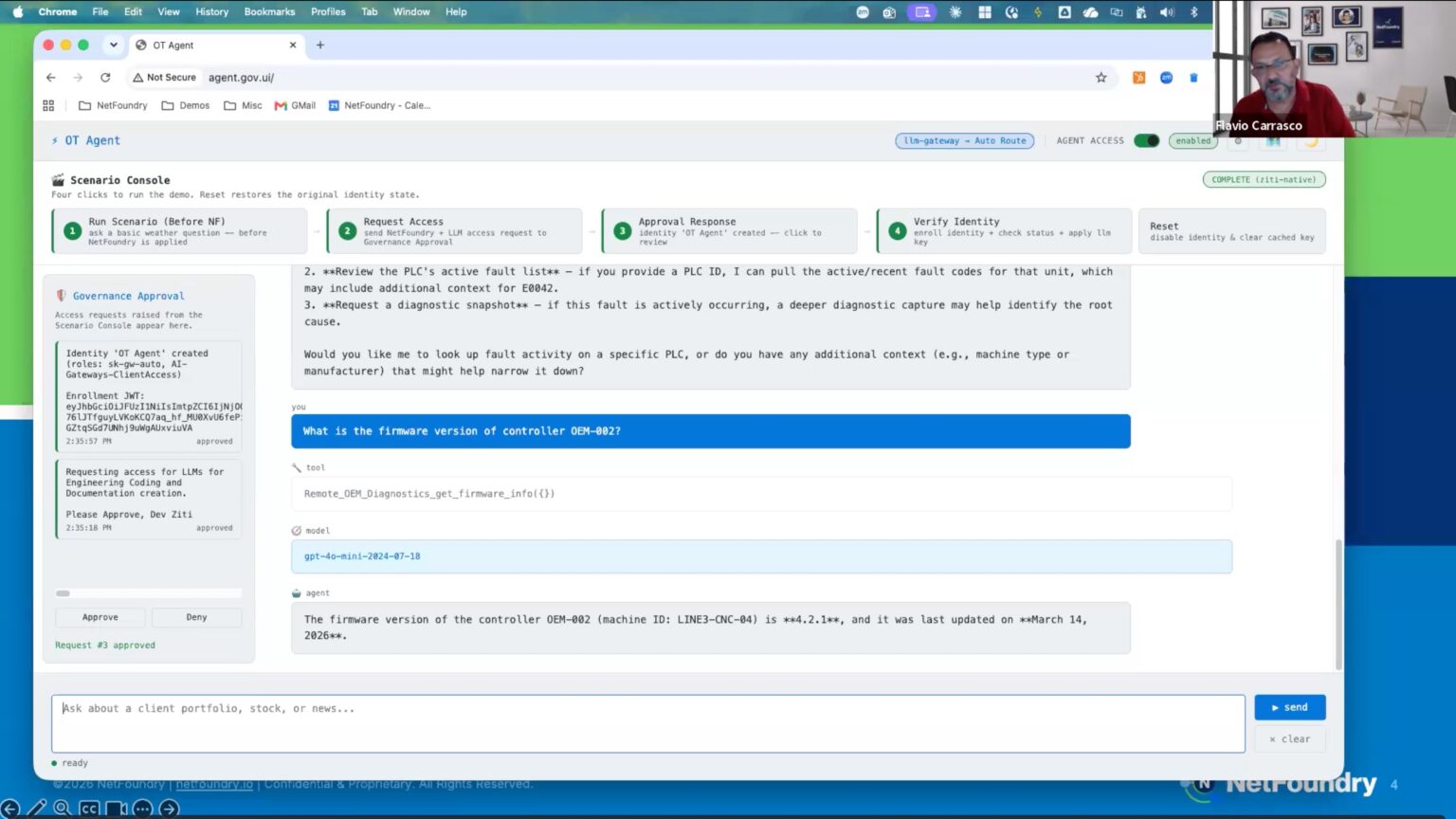
Discover how to safely deploy agentic AI within your operational technology environments. In this demo, NetFoundry Senior Sales Engineer Flavio Carrasco demonstrates robust AI security for OT networks. Watch how to assign cryptographic identities to AI agents, securely query PLC fault codes and controller firmware without opening inbound firewall ports, and instantly revoke access to protect your critical infrastructure from autonomous threats.
Key Takeaways
- Zero Inbound Attack Surface: NetFoundry operates entirely via outbound-only connections over standard port 443, eliminating the need to open vulnerable firewall ports for GPU instances or LLM gateways.
- Cryptographic Agent Identities: Access is granted by issuing agents strong X.509 certificates generated through built-in or external PKI integrations, ensuring strict, identity-driven governance.
- Accelerated Deployment & Reduced Overhead: By bypassing complex VPNs and routing databases, organizations can securely deploy AI connections in minutes, speeding up time-to-revenue while lowering operational costs.
Frequently Asked Questions
- Why is scaling AI securely a challenge for enterprises? Governance is frequently treated as an afterthought rather than a built-in feature, and observability remains poor, with over 80% of employees using unapproved AI tools that lack proper audit trails.
- How does NetFoundry secure agentic AI tools? The platform provisions a cryptographic X.509 identity to AI agents via an API call, granting them secure access to specific backend resources like LLM and MCP gateways.
- Do I need to reconfigure my firewalls to support this? No. The solution relies exclusively on port 443 outbound connections, meaning you do not need to open any inbound ports on your firewall.
- What happens if an AI agent falls out of compliance? Administrators can revoke the agent’s access instantly using a simple API call, causing all subsequent backend queries from the agent to immediately fail.
- What are the primary operational benefits of this Zero Trust approach? It significantly shortens security reviews, allows for same-day backend connections, and reduces operational maintenance by eliminating the need for traditional VPNs or meshes.
Full Transcription
Flavio Carrasco: Hello everyone, Flavio Carrasco, Senior Sales Engineer with NetFoundry. Today, I’m going to go over an AI demo and the challenges security teams face.
Scaling AI adoption safely is hard for CISOs, Chief Data Officers, and compliance leaders. Governance is often bolted on after rollout rather than built-in from the start. Policies and role-based access controls come later, and roughly one in five organizations has a mature AI governance model.
Security adds another layer of difficulty. Gateways must connect to GPU boxes sitting behind a NAT and open firewall ports to reach clients, while agentic AI introduces the added risk of autonomous action. Observability is thin. More than 80% of employees already use unapproved AI tools with no audit trail linking prompts, model decisions, and outcomes. Together, these gaps slow approvals, create regulatory exposures, and stall enterprise-wide rollouts.
In today’s demo, you have an AI agent needing access to backend resources with your LLM gateway and your MCP gateway. The AI agent will be routed through the governance team, which creates an identity with an API call to the NetFoundry platform. This identity is a cryptographic X.509 certificate generated through the platform’s built-in PKI infrastructure, with options to integrate external PKIs or an identity management platform like SPIFFE SPIRE.
As you can also notice, you have arrows pointing outwards. This is because all we need is port 443 outbound, and we don’t need to have any inbound ports open.
(Demo Walkthrough) If I run this agent without an identity or approvals, you can see I don’t have access to the backend resources; I’m not able to query the MCP gateways or the LLM gateways. So I need to request access for governance approval. They receive the request and can either approve or deny. You hit approve, and it prompts them to generate the identity via an API call to the NetFoundry platform. In this case, I’ll do the OT agent to use the MCP servers for the OT environment.
For the LLM keys, you can provide virtual keys, keys for Anthropic, local models, or “Auto,” which provides access to all three available LLM models. Once the identity is created, the approval is granted. A .jwt file is created and sent to the AI agent to enroll their identity into the NetFoundry platform. They click the approval, verify the identity using the .jwt file, and it is enrolled and ready to go.
Now I can start querying the MCP services for my OT environment. I can ask it to list the fault codes for PLC01. It reaches out to the OpenAI model, retrieves the active fault code (e.g., E204), and you can ask further questions based on the tools available. I could ask, “What’s the firmware of my controller?” and it retrieves that information and responds.
That’s how easy it was to enroll, go through the approval process, and start using the AI agent. Now, if it falls out of compliance and you no longer need it, you can disable access with a simple API call. If you ask additional questions (e.g., “What time is it?”), it will fail. You no longer have access; the agent is disconnected from the backend.
The business values of our platform include deploying in minutes rather than weeks. Security reviews get shorter because there are no open inbound ports to justify. Revenue lands faster because models and GPU backends connect the same day instead of waiting for lengthy security sign-offs. Operational costs drop because you don’t have to build or maintain VPNs, meshes, or routing databases. Security gets stronger through construction—Zero Trust access means there is no inbound attack surface from the start.
That’s it for today. Thank you, and stay tuned for additional recordings here in the near future.