
Zero Trust for Every Workload, Not Just Every User
Zero Trust taught security teams to stop trusting the network and start verifying identity. Zero Trust Workload Connectivity applies that same principle to the workloads themselves: every AI agent, MCP server, LLM, API, and OT/IoT system gets its own identity, reaches only what it is authorized to reach, and stays unreachable until that identity is verified. As AI multiplies the reachable attack surface, traditional connectivity built on VPNs, firewall rules, IP allowlists, and exposed APIs falls short. NetFoundry delivers Zero Trust Workload Connectivity through Identity-First Reachability™: every workload initiates its connections outbound, keeps inbound ports closed, and authorizes access at the service level rather than the network level.
Zero Trust Workload Connectivity is how an enterprise extends Zero Trust from its users to its workloads. In practice, it means connecting workloads — AI agents, MCP servers, LLM endpoints, APIs, services, and devices — so that each one reaches only the specific resources it is authorized to reach and stays invisible to everything else. NetFoundry delivers it through Identity-First Reachability™, a model in which every workload receives its own cryptographic identity and becomes reachable only after that identity is authenticated and authorized against policy. Each workload initiates its connections outbound, every session stays end-to-end encrypted, and NetFoundry re-evaluates identity and policy continuously for the lifetime of the session. From the network’s perspective, protected workloads stay invisible by default, and inbound ports stay closed without exception.
This posture differs fundamentally from the one most enterprises operate today. In a traditional architecture, services are reachable on the network first and authenticated second. That ordering — reachable, then authenticated — is the structural source of most modern breaches. Secure workload connectivity inverts it: nothing is reachable until identity has been proven and policy has authorized the interaction.
Most enterprise connectivity still rests on a stack of controls designed for a different era: VPNs that grant broad network access once a user is in, firewalls and IP allowlists that gate traffic by address rather than identity, secrets and API keys spread across teams and tools, and APIs deliberately exposed to “the right networks” so they can be consumed.
Each control solves a narrow problem, but together they create the same structural condition: services are reachable on the network before any identity decision is made. An attacker who reaches the endpoint can probe it, exploit it, and pivot from it. A misconfigured rule, a leaked credential, or an unpatched CVE becomes a path to lateral movement because the reachability was there first.
This model also imposes operational drag. Every new AI agent, partner integration, or edge device triggers firewall changes, VPN provisioning, IP allowlist updates, and security reviews — the very work that slows enterprises down precisely when AI forces them to move faster.
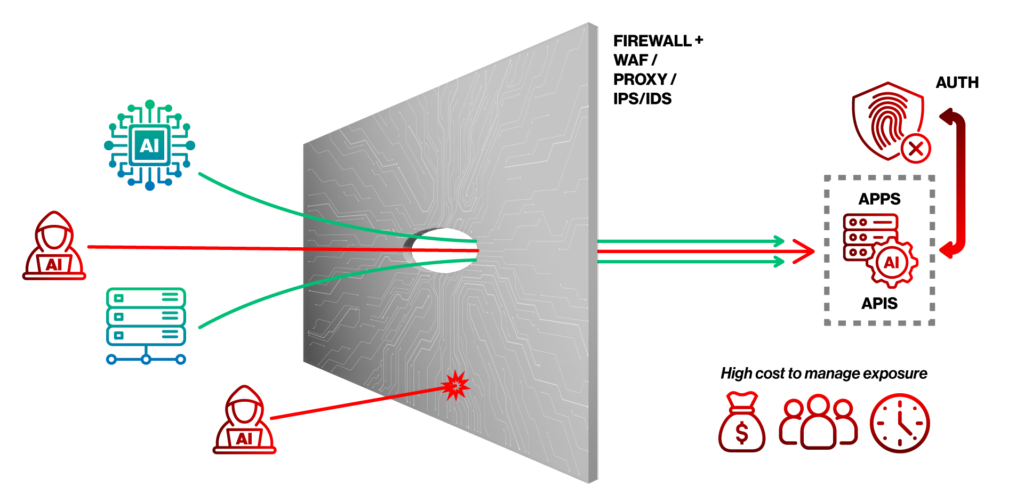
The fundamental security problem of the AI era is reachability. Every API, AI agent, MCP server, and LLM endpoint exposed to the network is a potential entry point, and attackers now exploit reachable endpoints faster than defenders can patch, restrict, or detect them.
For AI systems, the reachability problem compounds. AI agents discover and interact with tools dynamically. MCP servers and APIs stay broadly reachable by design. Secrets and API keys proliferate across teams. Employees adopt unauthorized AI tools when official rollouts move too slowly. And every change to the underlying infrastructure — a firewall rule, a VPN configuration, a routing policy — slows AI deployment at exactly the moment the business is under the most pressure to execute.
Zero Trust Workload Connectivity addresses this directly. By eliminating the reachable surface, it removes the attack vector. By using identity rather than network position to authorize access, it lets platform teams roll out agents, gateways, and services at software speed, with no firewall changes, no VPN provisioning, and no new exposed endpoints.
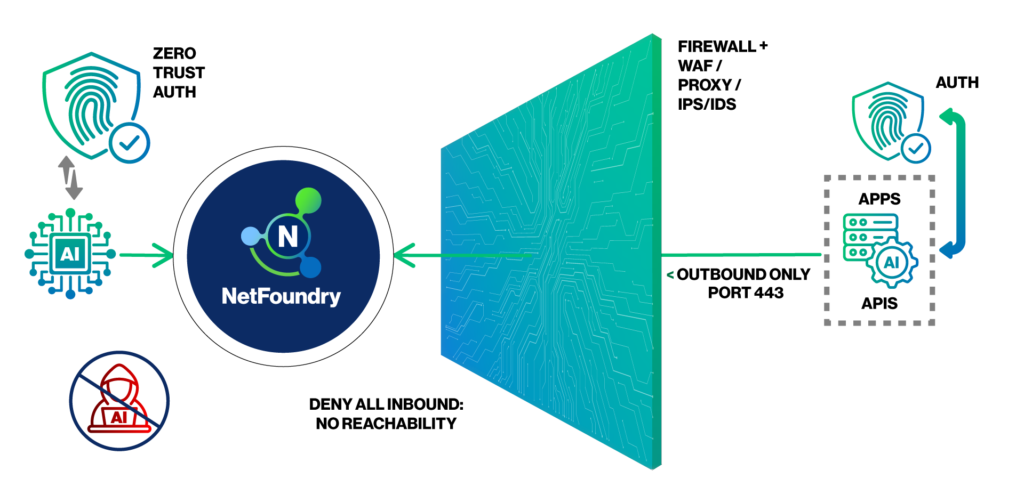
Two forces arriving at once are driving the shift to Zero Trust Workload Connectivity: a new dominant breach vector and an explosion of AI-driven attack surface.
Vulnerability exploitation is now the #1 breach vector, surpassing phishing and credential abuse combined. Attackers go after what they can reach, and reachable endpoints are the consistent through-line across breaches.
Shadow AI compounds the exposure. Roughly 68% of employees already use unauthorized AI tools they brought in themselves, because official rollouts moved too slowly. Each of those tools represents an unmanaged identity, an unmanaged endpoint, and an unmanaged data flow.
Identity-First Reachability is the right model for Zero Trust Workload Connectivity because it removes the structural condition that makes modern breaches possible — reachability before authentication — and replaces it with an approach that matches how AI, APIs, and distributed workloads actually communicate today.
It is built for outbound-initiated, service-to-service interaction, the dominant pattern in agentic AI and microservice architectures. It scales without firewall changes, VPN tunnels, or IP allowlists, and deployment speed keeps pace with the software teams deploying it. It also provides a unified identity and policy plane across cloud, on-prem, hybrid, and air-gapped environments, so the same model applies whether the workload is a Fortune 10 financial transaction or a sovereign agent calling a private LLM.
The result is a model that deploys faster than the incumbent stack and proves meaningfully more secure, because it removes the attack surface incumbents spend their time defending.
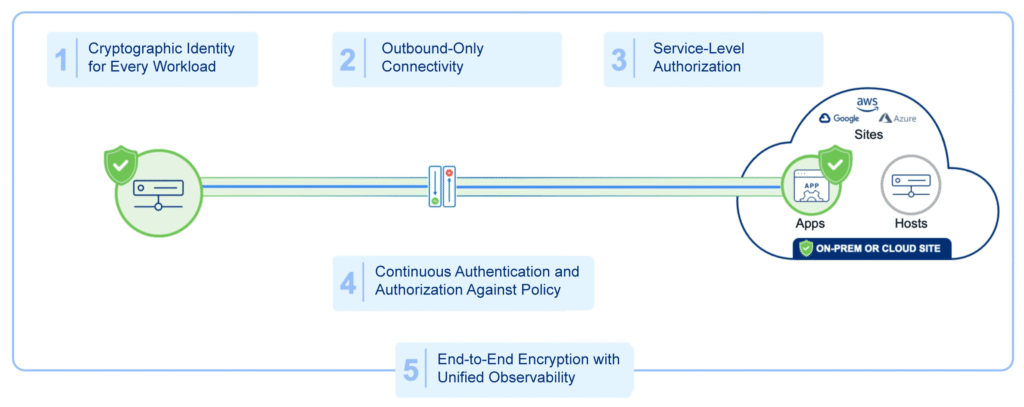
NetFoundry implements Zero Trust Workload Connectivity through five reinforcing principles. Together they define how a workload — an AI agent, an MCP server, an LLM endpoint, an API, or an OT device — connects and stays protected.
Every endpoint receives its own sovereign cryptographic identity. Agents, services, and devices share no API keys, service accounts, or bearer secrets. Identity binds to the workload itself rather than to a network location or a shared credential, so no secret exists to leak, rotate, or exfiltrate.
No workload listens for inbound connections on the network. Each side initiates its sessions outbound, and the two meet inside the enclave only after both identities authenticate and authorize. From the outside, the protected services stay invisible — no ports to scan, no endpoints to enumerate, and no perimeter to breach.
Authorization decisions happen at the service level, not the network level. An identity gains access to a specific service, tool, or endpoint rather than to a network segment, subnet, or IP range. This eliminates the lateral movement that follows network-level access and shrinks the blast radius of any compromise to a single service.
Authentication and authorization are not a one-time gate at session start. NetFoundry re-evaluates each session against current identity and policy state. When a policy changes, an identity is revoked, or context shifts mid-session, the change takes effect immediately. Access can be granted just-in-time and revoked the same way, with no tunnel to drop or credential to expire.
Every session is end-to-end encrypted by default, with no plaintext intermediary. Because every flow ties to an identity rather than an IP address, observability becomes meaningful: platform teams trace a request from an agent through an LLM call to a tool invocation in a single audit trail. Cost, behavior, policy violations, and risk roll up against identities, so the data serves governance, billing, and incident response without correlation engineering.
Virtual Private Networks were designed to give remote users access to internal networks. Once a user authenticates, the VPN places them onto a network segment, and any service reachable on that segment becomes reachable to them. VPNs treat the network as the unit of access.
That model is poorly matched to AI workloads and service-to-service traffic. AI agents do not need a network — they need a specific tool, model, or API. Granting an agent VPN-level access to reach one MCP server gives it incidental reachability to every other service on that segment.
Identity-First Reachability replaces VPN-level network access with identity-bound, service-level access. No network segment, no tunnel, no broad allowlist. Each agent reaches exactly the services its identity authorizes, and nothing else.
Firewalls and IP allowlists gate traffic by address. They assume that an attacker cannot easily appear at an allowed IP and that the set of trusted addresses stays small and stable. Neither assumption holds in modern environments where workloads are ephemeral, addresses shift, and cloud egress IPs are shared across tenants.
Operationally, firewalls and allowlists also create drag. Every new AI agent, partner integration, or model endpoint becomes a change request, a review, and a deploy. The slower the firewall pipeline moves, the more shadow IT and shadow AI fill the gap.
Identity-First Reachability removes both problems. Identity, not address, becomes the unit of trust. New workloads come online by receiving an identity rather than by punching a hole in a firewall, and because all connectivity is outbound, the firewall never needs reconfiguring each time a new service is added.
Secure Access Service Edge (SASE) unifies networking and security at the cloud edge, primarily to secure user traffic to SaaS and internet destinations. It is a strong model for the workload it was designed for: human users browsing the web from anywhere.
It fits AI infrastructure less well. SASE architectures often struggle with AI applicability because servers are not directly connected to the SASE fabric and AI applications frequently use direct API calls that bypass traditional SASE control points. AI traffic is service-to-service, often east-west, and often inside a customer’s cloud or data center — exactly the topology SASE was not built for.
Identity-First Reachability complements SASE on the user-edge use case rather than competing with it, and it is the right model for the service-to-service, agent-to-tool, and AI-infrastructure traffic that SASE cannot natively reach.
SD-WAN optimizes WAN connectivity across branches, clouds, and data centers, typically using signature-based traffic steering and policy applied at network appliances. It excels at routing predictable traffic over the right link.
AI traffic is not predictable. Model selection, agent behavior, retrieval patterns, and tool calls produce highly variable flows that defeat signature-based steering and bypass appliance-level control when calls go directly to API endpoints. SD-WAN modernized the links, not the trust model: it provides no workload identity, authorizes nothing at the service level, and eliminates no reachable endpoints.
Identity-First Reachability operates a layer above the WAN. It does not replace the underlying transport — it makes the transport irrelevant to security. The same identity, policy, and authorization apply whether the traffic crosses MPLS, internet, or a private cloud interconnect.
Traditional Zero Trust Network Access focuses on user-to-application access, typically by brokering connections from authenticated users to private applications via a cloud-hosted proxy. It is an important step beyond VPNs for human workforce use cases.
But traditional ZTNA still orients around users and applications. It does not natively model machine-to-machine identity at the workload level, does not eliminate inbound listening on the protected services, and does not extend cleanly to AI agents, MCP servers, or OT/IoT devices that need to talk to each other at scale.
Identity-First Reachability extends the Zero Trust principle from the user edge to the workload itself. Every workload — human-driven or autonomous — is an identity. Every service stays invisible until that identity is authorized. No inbound listener, no exposed application, and no broker that becomes a single point of compromise.
Most AI deployments today distribute API keys and service account credentials to the agents and services that need them. Secret managers help rotate and inject those credentials, but they do not eliminate the underlying problem: the secret is what authenticates, and any holder of the secret can act.
Leaked keys, over-permissioned service accounts, and shared bearer tokens remain the dominant pattern in AI agent compromise. Token theft requires no network exploit — it just requires reaching a place where a secret is stored, logged, or transmitted.
Identity-First Reachability reduces the need for shared secrets and API keys and eliminates an attacker’s ability to reach them. Workloads authenticate with their cryptographic identity rather than a shared key. For access to the secure enclave, no API key exists to steal, leak, or exfiltrate. Per-identity policy, per-identity cost tracking, and per-identity audit replace the secret-based model with something both more secure and more accountable.
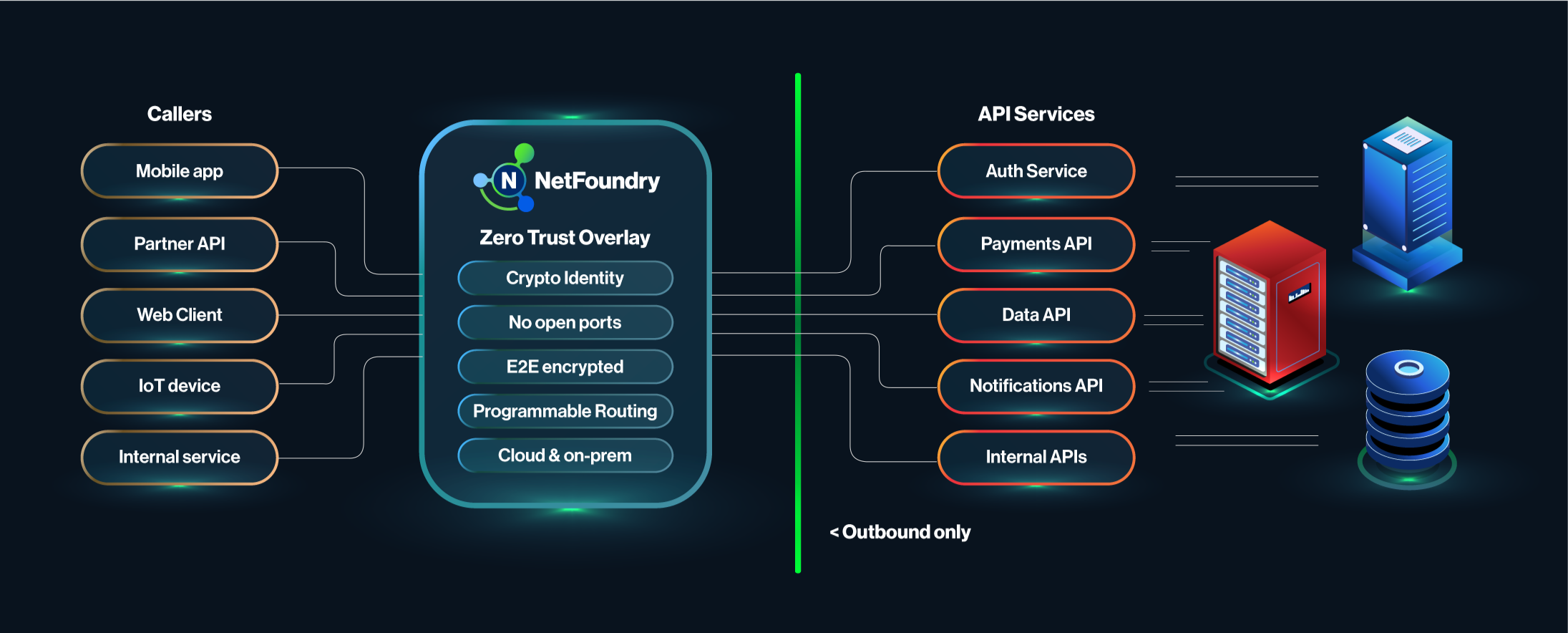
Most enterprises operate across cloud, on-prem, hybrid, edge, and, increasingly, air-gapped environments. AI workloads in particular tend to span all of them: a model hosted in one cloud, an agent running on-prem, a tool in a partner environment, and an inference workload that must stay inside an air-gapped enclave for regulatory or sovereignty reasons.
Zero Trust Workload Connectivity is designed for this full landscape. The same identity, policy, and authorization model applies in every environment, and because connectivity is outbound-initiated and identity-bound, the underlying network topology does not change to add a new site, cloud, or air-gapped enclave. NetFoundry’s MCP and LLM Gateways run across self-hosted and public LLMs and support on-prem (including air-gapped), hybrid, and cloud deployments.
The result is a single connectivity and security model that follows the workload, not the network it happens to be running on.
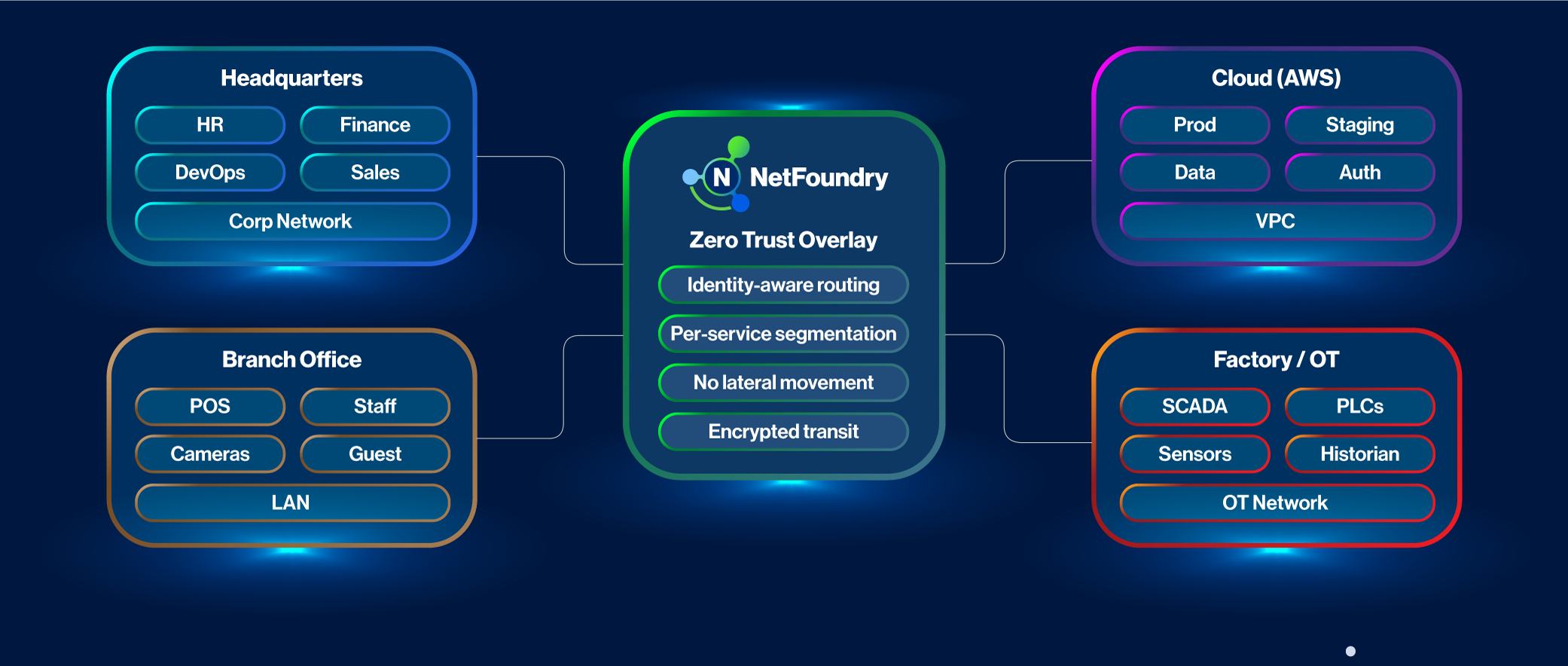
The fastest-growing application of Zero Trust Workload Connectivity is securing agentic AI. AI agents, MCP servers, and LLM endpoints expand exactly the kind of reachable attack surface attackers know how to exploit. NetFoundry’s Zero Trust AI Enclave applies Identity-First Reachability™ to that environment end to end.
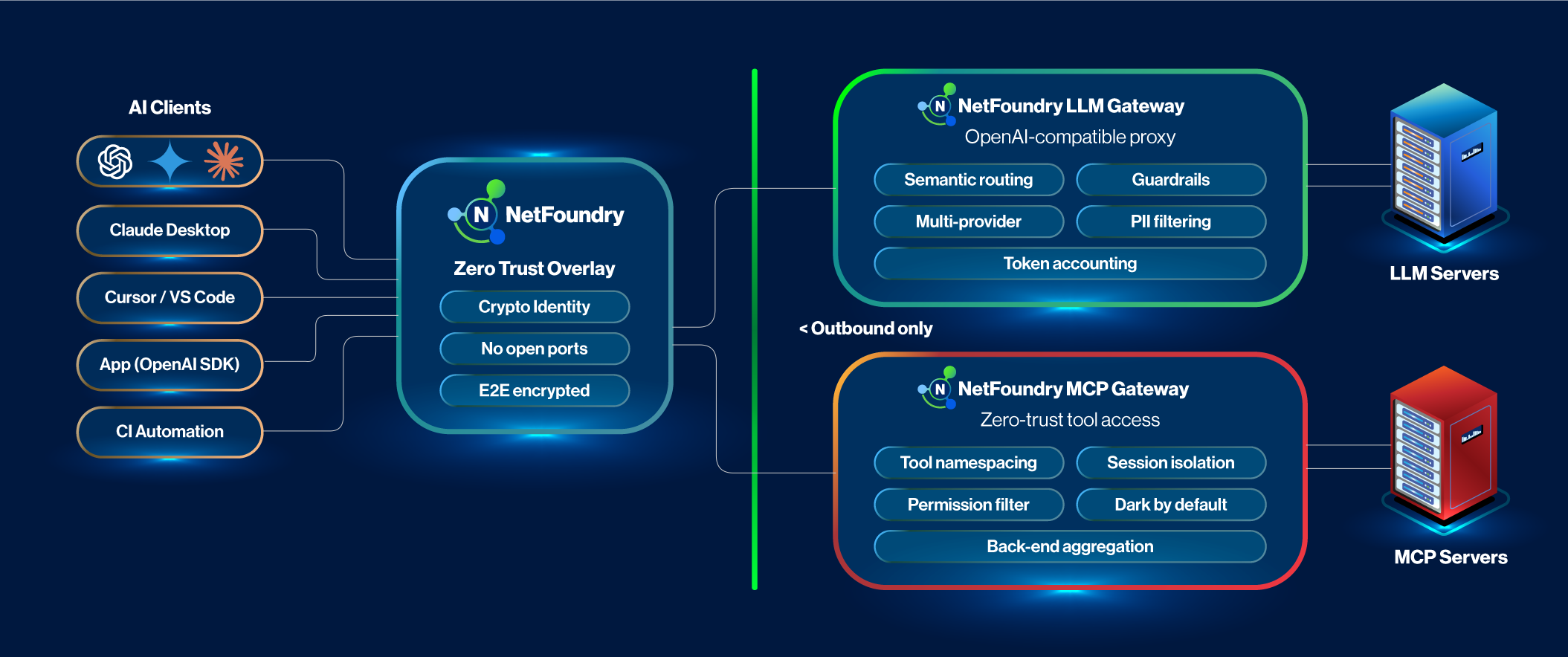
Inside a Zero Trust AI Enclave, every AI agent, MCP server, and LLM endpoint receives its own cryptographic identity. Authorization happens at the service level. All connections initiate outbound, stay end-to-end encrypted, and undergo continuous authentication against identity and policy. From the network’s perspective, the AI infrastructure stays invisible until identity and policy authorize the interaction, and inbound ports stay closed.
The MCP Gateway delivers Zero Trust access to MCP servers from any MCP-compatible client without exposing those servers to the network. It supports multi-backend aggregation, tool namespacing, structural permission filtering, per-client session isolation, centralized multi-user management, role-based access control, and a full enterprise UI. Denied tools disappear from the registry entirely — removed from the schema before a client ever sees them, not checked at runtime.
The LLM Gateway provides governed, OpenAI-compatible access to providers including OpenAI, Anthropic, Azure OpenAI, AWS Bedrock, Google Vertex AI, and private Ollama instances, without distributing API keys or opening ports to inference infrastructure. A three-layer semantic routing cascade (heuristics, embeddings, and an optional LLM classifier) routes each request to the right model for cost, latency, or data sensitivity. Built-in guardrails cover PII detection, content safety filtering, topic controls, and prompt injection detection, and per-identity cost tracking and budget enforcement give platform and finance leaders full visibility into AI spend by team and project.
Together, the gateways share a unified identity model, correlated observability, and coordinated governance, so platform teams trace a request from agent through LLM call to tool invocation in a single audit trail.
| AI Connectivity Challenge | Zero Trust Workload Connectivity Outcome |
|---|---|
| Deployments slowed by network change requirements | Outbound-only connectivity removes the need for VPN, firewall, or routing changes, so agents and gateways come online at software speed. |
| Expanded attack surface from exposed agents, MCP servers, and LLM endpoints | The AI Enclave stays invisible from the outside. NetFoundry authenticates every connection before it is established and governs every flow by policy. |
| Poor visibility into AI activity across networks | Every flow ties to a workload identity rather than an IP address, so cost, behavior, and policy compliance become directly observable per agent, model, and team. |
| Secret sprawl from distributed API keys | Workloads authenticate with cryptographic identity, which eliminates shared secrets entirely. |
| Shadow AI from slow official rollouts | Platform teams stand up governed, identity-first AI access in hours, which removes the incentive for employees to bring in unauthorized tools. |
For organizations preparing for the next wave of AI infrastructure, the NetFoundry Accelerator Program offers early access to capabilities including the Agent2Agent (A2A) network — a Zero Trust fabric for governed, identity-based agent-to-agent communication.
NetFoundry pioneered Identity-First Reachability™ and leads the market for Zero Trust Workload Connectivity. The company was founded by the inventors and maintainers of OpenZiti, the world’s most widely used open source Zero Trust platform. That heritage matters: the model is proven at scale, the protocol is open, and the platform is the commercial-grade implementation of a battle-tested foundation.
NetFoundry secures billions of sessions for critical infrastructure across three continents and supports Fortune 10 companies across regulated industries including healthcare, financial services, and energy. The product set spans the full stack: NetFoundry’s AI Enclave brings Zero Trust Workload Connectivity to agentic AI infrastructure, with the MCP Gateway and LLM Gateway as the first commercial products purpose-built to apply the model to AI workloads. The same fabric extends to APIs, OT/IoT infrastructure, partner integrations, and human access — one identity-first model, one policy plane, one audit trail.
“NetFoundry enables Rhapsody to securely connect different types of sites and workloads, including AI agents, APIs and humans.”
Kevin Day, CTO, Rhapsody Health
“Vulnerability exploitation is the #1 breach vector today, surpassing phishing and credential abuse combined, because attackers go after what they can reach. With AI agents, MCP servers, and LLMs, enterprises are rapidly expanding exactly the kind of reachable attack surface that attackers know how to exploit. Identity-First Reachability™ eliminates that surface. Our commercial MCP and LLM Gateways make AI infrastructure invisible by default — so enterprises can deploy at software speed without handing attackers a larger target.”
Galeal Zino, CEO and Founder, NetFoundry
See how NetFoundry applies Zero Trust Workload Connectivity to AI agents, MCP servers, and LLMs, with the MCP Gateway and LLM Gateway making your AI infrastructure invisible by default.
NetFoundry delivers Zero Trust Workload Connectivity through Identity-First Reachability™, a connectivity and security model in which every workload — whether AI agent, MCP server, LLM endpoint, API, service, or device — receives its own unique digital identity and becomes reachable only after that identity is verified and authorized by policy. Each workload initiates its connections outward, every session stays end-to-end encrypted, and NetFoundry continuously re-evaluates identity and policy for the lifetime of the session. From the outside, protected workloads stay completely invisible, with no open ports, no exposed endpoints, and nothing for an attacker to find.
NetFoundry replaces VPN-level network access with identity-bound, service-level access. A workload reaches only the specific service its identity authorizes, with no shared network segment in between. A VPN places a user or workload onto a network segment, which makes everything else reachable on that segment reachable to them too — a far larger exposure than the task requires. With Identity-First Reachability™, no tunnel exists to compromise and no incidental access exists to exploit.
NetFoundry extends the Zero Trust principle beyond traditional ZTNA’s focus on user-to-application access and applies it to every workload, including AI agents, MCP servers, LLM endpoints, APIs, and OT/IoT devices, so no workload ever sits open on the network waiting for incoming connections. Traditional Zero Trust Network Access brokers connections from authenticated users to private applications through a cloud-hosted proxy, but it does not natively handle machine-to-machine traffic at the workload level or the autonomous, service-to-service patterns that AI infrastructure requires. With NetFoundry, there is no exposed application, no open entry point, and no broker that becomes a single point of failure.
NetFoundry requires no firewall changes, VPN provisioning, or routing updates because every workload initiates its connections outward. New agents, gateways, or services come online without touching the underlying network infrastructure. Traditional connectivity models force every new endpoint to trigger a change request, a security review, and a multi-team deployment — the drag that slows AI rollouts and pushes employees toward unauthorized tools. With NetFoundry, deployment speed matches the speed of the software teams doing the deploying, no matter how many new workloads come online.
NetFoundry secures AI infrastructure by making it invisible. Every AI agent, MCP server, and LLM endpoint receives its own unique digital identity and stays unreachable from the network until that identity is verified and policy authorizes the interaction. This directly addresses the two compounding problems AI creates: a dramatically expanded attack surface from exposed endpoints, and the operational friction of firewall changes and VPN provisioning that slows official AI rollouts and pushes employees toward unauthorized tools. The result is AI infrastructure that deploys faster and resists attack.
NetFoundry applies the same identity, policy, and authorization model in every environment — cloud, on-prem, hybrid, and air-gapped alike — and adds a new site, cloud, or isolated enclave with no changes to the underlying network. NetFoundry’s MCP and LLM Gateways run across self-hosted and public LLMs and support on-prem (including air-gapped), hybrid, and cloud deployments. One connectivity and security model follows the workload, wherever it runs.
NetFoundry authenticates workloads with a unique digital identity rather than shared passwords or API keys, removing the shared credential from authentication entirely, so nothing exists to steal, leak, rotate, or accidentally expose. Most AI deployments today distribute API keys and account credentials to the agents and services that need them. Secret managers help rotate and store those credentials, but the key itself remains the basis for authentication, so anyone who obtains it can act with full permissions. NetFoundry replaces that model with per-identity policy, per-identity cost tracking, and per-identity audit — both more secure and more operationally accountable.
NetFoundry’s Zero Trust AI Enclave is a purpose-built secure environment for AI workloads, where every AI agent, MCP server, and LLM endpoint receives its own unique digital identity, every connection runs outbound-only and end-to-end encrypted, and the entire enclave stays invisible from the outside until identity and policy authorize an interaction. It addresses the specific exposure agentic AI creates: AI agents discover and interact with tools dynamically, MCP servers and APIs stay broadly reachable by design, and credentials proliferate across teams. The enclave eliminates each of these conditions. Platform teams deploy and govern AI infrastructure at software speed, without firewall changes, exposed endpoints, or distributed API keys.
NetFoundry’s MCP Gateway provides secure, identity-verified access to MCP servers without exposing them to the network, with support for multiple backends, tool-level permission filtering, and isolated sessions per client, so each user or agent sees only the tools it is authorized to use. NetFoundry’s LLM Gateway delivers governed access compatible with leading AI providers, including OpenAI, Anthropic, Azure OpenAI, AWS Bedrock, Google Vertex AI, and private Ollama instances, without distributing API keys or opening ports to inference infrastructure. Together they share a unified identity model and correlated observability, so platform teams can trace a request from agent through LLM call to tool invocation in a single audit trail.
NetFoundry’s LLM Gateway reduces AI token costs by up to 50% through intelligent routing that sends each request to the right model based on cost, speed, and data sensitivity. Expensive frontier models handle only the requests that truly require them. Combined with per-identity budget controls, organizations gain full visibility into AI spend by team and project, replacing the opaque, uncontrolled cost model that follows from distributing API keys directly to agents and developers. The same identity-first layer delivers both cost reduction and security enforcement, with no separate tooling required.
NetFoundry secures billions of sessions for critical infrastructure across three continents and supports Fortune 10 companies across regulated industries including healthcare, financial services, and energy. Customers adopt NetFoundry specifically to eliminate exposed attack surfaces across AI agents, APIs, OT/IoT devices, and partner integrations, all under a single identity and policy plane. NetFoundry is also the company behind OpenZiti, the world’s most widely used open source Zero Trust platform.
NetFoundry offers two paths to get started: get in touch to talk to the team about a Zero Trust AI Enclave deployment, or apply to the NetFoundry Accelerator Program for early access to upcoming capabilities including the Agent2Agent (A2A) network.
NetFoundry is the leading secure networking platform for distributed enterprises, built on Identity-First Reachability™ — a model where every workload receives its own unique digital identity, initiates its connections outward, and keeps inbound ports closed. Founded by the inventors and maintainers of OpenZiti, the world’s most widely used open source Zero Trust platform, NetFoundry secures billions of sessions for critical infrastructure across three continents and supports Fortune 10 companies in healthcare, financial services, and energy. Distributed enterprises adopt it because adding new sites, agents, or services requires no firewall changes, no VPN provisioning, and no routing updates.
NetFoundry supports both on-premises (including air-gapped) and cloud workloads under a single identity and policy plane, applying the same unique digital identity, outbound-only connection model, and service-level access controls whether a workload runs in AWS, Azure, GCP, a private data center, or a regulated isolated environment. This removes the common pattern of stitching together separate tools per environment — one for cloud, one for VPN, one for OT — and the operational complexity of maintaining parallel policy models. NetFoundry’s AI Enclave, MCP Gateway, and LLM Gateway all run across self-hosted and public LLMs and support on-prem (including air-gapped), hybrid, and cloud deployments.
NetFoundry is the leading cloud-native Zero Trust networking platform, built on OpenZiti — the open source Zero Trust framework NetFoundry invented and maintains, now the world’s most widely used implementation of the model. NetFoundry’s commercial platform delivers Zero Trust Workload Connectivity across cloud, on-prem, edge, and AI workloads with a single identity, policy, and observability plane, operating above the transport layer rather than relying on network-segment models like legacy VPNs or cloud-overlay tunnels. When evaluating any Zero Trust networking platform, the defining capability is whether it eliminates the exposed attack surface entirely — issuing each workload its own unique digital identity and closing inbound ports — or whether it still relies on tunnels, allowlists, and shared credentials.
NetFoundry automates Zero Trust overlay deployment and management through identity-based policy defined centrally and applied automatically across every environment. Because policy binds to workload identity rather than IP address or network location, changes take effect instantly — access can be granted just-in-time or revoked the same way — and new sites, services, agents, and gateways come online by receiving an identity rather than by provisioning tunnels or modifying firewalls. The underlying overlay protocol is OpenZiti, invented and maintained by NetFoundry, which provides the open programmable foundation; the NetFoundry platform adds the enterprise control plane, observability, and lifecycle automation on top.
NetFoundry is purpose-built for multicloud connectivity, replacing the traditional approach of stitching environments together with VPNs, network peering, and firewall rules with a single identity-bound fabric that follows the workload, not the network. Because every connection initiates outbound and access is granted at the individual service level, adding a new cloud, region, or partner requires no new tunnels or routing changes, which suits deployments where identity, policy, and visibility must stay consistent across providers. AI workloads benefit in particular, since they typically span cloud, on-prem, edge, and air-gapped environments at the same time.
NetFoundry is purpose-built for AI application traffic, giving every AI agent, MCP server, and LLM endpoint its own unique digital identity through its Zero Trust AI Enclave, with access granted at the individual service level rather than the network level. The MCP Gateway provides secure access to MCP servers without exposing them to the network, with support for multiple backends, tool-level permissions, and isolated sessions per client, while the LLM Gateway delivers governed, OpenAI-compatible access to providers including OpenAI, Anthropic, Azure OpenAI, AWS Bedrock, Google Vertex AI, and private Ollama instances, with intelligent routing that can reduce AI token costs by up to 50%. Traditional SASE architectures struggle with AI traffic because servers are not directly connected to the SASE fabric and AI applications frequently use direct API calls that bypass traditional control points — exactly the gap NetFoundry’s identity-first model closes.
NetFoundry is the fastest path to Zero Trust deployment for IoT and IT environments because it eliminates the steps that traditionally dominate rollout timelines — VPN provisioning, firewall rule changes, IP allowlists, and per-environment policy reconciliation. New IoT devices and IT workloads come online by receiving a unique digital identity rather than by opening inbound ports, and the same identity, policy, and visibility layer covers IoT, OT, IT, cloud, and AI workloads in a single fabric. Because no underlying network changes are required, teams stand up governed, identity-first access without the long change-control cycles that slow traditional Zero Trust rollouts.
NetFoundry is purpose-built for mixed IT and OT environments, applying the same identity-first model across both under a single fabric with no open inbound ports, no VPNs, and no firewall changes. NetFoundry supports OT and IoT infrastructure alongside AI agents, MCP servers, LLMs, and APIs — which matters in OT specifically, where open ports and shared credentials create serious exposure on systems that often cannot be patched quickly. By issuing each device a unique digital identity and granting access only at the individual service level, NetFoundry removes OT systems from the exposed attack surface while maintaining a unified policy and audit model across IT and OT.
NetFoundry solves the core reason enterprises struggle with Zero Trust networking: most platforms layer new abstractions on top of the same network-centric assumptions that created the problem — tunnels, IP allowlists, exposed application brokers, and per-environment policy models that each become a change request, a security review, and a multi-team deployment. This operational drag carries real consequences: roughly 68% of employees admit to using unauthorized AI tools because official rollouts moved too slowly, expanding attack surface through unmanaged identities and unmanaged data flows. NetFoundry avoids this with a single identity-bound fabric — no tunnels to provision, no firewalls to reconfigure, no parallel policy models per environment — across cloud, on-prem, edge, IoT, OT, and AI workloads.
NetFoundry eliminates the core source of multicloud connectivity complexity: each cloud provider brings its own networking model, identity system, and policy language, which forces teams to stitch environments together with VPNs, network peering, allowlists, and per-cloud security rules into a brittle web of exceptions where the slowest provider’s change pipeline sets the whole organization’s deployment speed. NetFoundry solves this by issuing every workload its own unique digital identity, initiating all connections outward, and granting access at the individual service level, which makes the underlying cloud infrastructure irrelevant to security. The result is a single policy and audit model that applies consistently across every environment, where adding a new cloud, region, or partner requires no new tunnels, no routing changes, and no policy reconciliation.
NetFoundry currently secures its data plane and control plane with libsodium, a modern, well-audited cryptographic library built on proven classical algorithms such as Curve25519, ChaCha20-Poly1305, and Ed25519. Cryptographically relevant quantum computers capable of breaking these algorithms do not exist today, but the security industry treats their eventual arrival as a planning requirement, particularly for long-lived sensitive data and regulated environments.
NetFoundry’s response starts with architecture, not a single algorithm swap. NetFoundry builds cryptography as a pluggable component within an identity-first Zero Trust fabric, separating cryptographic primitives from the identity, policy, service and transport logic that make up the rest of the platform. This separation gives NetFoundry a path to introduce, test and roll out new algorithms, including post-quantum ones, without redesigning the platform or forcing customers to re-architect their deployments.
This is where identity-first reachability matters. Traditional topology-based controls often make cryptographic migration dependent on every router, firewall, proxy, gateway, WAF, TLS inspection point, legacy application and middlebox in the path. Each system that must terminate, inspect, parse or understand the connection becomes another migration dependency. NetFoundry’s overlay model reduces that dependency chain by placing cryptographic and reachability decisions at controlled service boundaries, tied to identity, policy and context.
Importantly, this abstraction works in both directions. The underlay can continue to carry standard TLS/mTLS overlay transport, so existing network infrastructure does not need to become PQC-aware merely to forward traffic. At the same time, applications do not necessarily need to implement PQC directly on day one. Stronger cryptography, including hybrid-PQC or PQC, can be introduced inside the overlay for selected sensitive service flows, then moved closer to the workload, host, application or SDK as requirements mature.
This means PQC migration does not have to be an all-or-nothing refresh of either the application estate or the underlying hardware estate. For some services, the right end state may be true E2E PQC at the application or SDK boundary. For others, especially OT, tactical, M2M, remote access or constrained WAN paths, the practical first step may be to protect traffic at controlled overlay boundaries while legacy systems and underlay infrastructure remain unchanged.
FIPS 140-3 follows the same abstraction principle. Rather than lock the platform to one cryptographic library or require every environment component to support the same cryptographic capability at the same time, NetFoundry’s architecture allows stronger or validated cryptography to be introduced at controlled overlay boundaries for customers and workloads that require it. The same pattern applies to PQC: quantum-safe protection can be introduced service by service, starting with the highest-risk workflows, without waiting for the entire brownfield estate to become PQC-aware.
NetFoundry’s path to PQC follows the staged approach the broader security industry has converged on. NIST finalized its first PQC standards in August 2024: FIPS 203 for ML-KEM key encapsulation, FIPS 204 for ML-DSA digital signatures, and FIPS 205 for SLH-DSA signatures. Consistent with that guidance, NetFoundry expects PQC adoption to begin with hybrid approaches that combine classical and post-quantum algorithms before moving towards PQC-native configurations as libraries, hardware acceleration, interoperability and compliance frameworks mature.
In short, crypto-agility is not a future feature bolted onto NetFoundry’s architecture; it is an outcome of the architecture itself. By moving from topology-based controls to identity-first reachability, NetFoundry can make FIPS 140-3 and PQC adoption more operationally achievable: stronger cryptography can be introduced in stages, at controlled service boundaries, while both applications and underlay infrastructure modernize over time.
NetFoundry separates a network into three functional layers, and each layer can sit in a different location depending on the deployment model you choose. The Data Plane carries your application traffic. The Control Plane authenticates identities and enforces policy. The Orchestration Plane holds the network’s configuration. The table below shows where NetFoundry stores or processes five categories of data, comparing a NetFoundry-hosted deployment against one you self-host.
| Data Category | NetFoundry Hosted | NetFoundry Self-Hosted |
|---|---|---|
| Configuration and policy | NetFoundry authors and stores this in its multi-tenant Orchestration Plane, then replicates the live, enforceable copy to a single-tenant Control Plane in an NF Cloud data center. NetFoundry tokenizes the orchestration copy: NetFoundry holds it, but the data carries no meaning outside internal correlation. | You host both the Orchestration Plane and the Control Plane in your own environment, so configuration and policy data never leaves it. |
| Identity context | Your network’s dedicated Control Plane (a single-tenant Ziti controller) authenticates endpoints and services and issues API session tokens. NetFoundry hosts this controller in the AWS or OCI data center you select. | You host the Control Plane, so identity verification never leaves your environment. |
| Session and access logs | NetFoundry’s telemetry pipeline buffers these events and enriches them with identity and service context by querying the Control Plane, then indexes them for search. In NF Cloud, this pipeline runs alongside the Control Plane, in the region you selected for it. | You deploy and operate the equivalent logging pipeline yourself — NetFoundry publishes it as a self-hosted Helm chart — so logs stay in your environment. |
| Metrics and session metadata | Metrics flow through the same buffering-and-indexing pipeline as session and access logs and follow the Control Plane’s region. | You host this alongside the rest of your logging stack. |
| Traffic handling (Data Plane) | NetFoundry hosts your Data Plane as single-tenant by default and end-to-end encrypted, so NetFoundry cannot read your traffic even though it hosts the routers. You pick the geolocation from any AWS, Azure, OCI, or GCP data center. | You host every router, so traffic never touches NetFoundry infrastructure. |
When NetFoundry hosts your Data Plane, you can select the geolocation from any AWS, Azure, OCI, or GCP data center. When NetFoundry hosts your Control Plane, today’s selectable footprint narrows to any AWS or OCI data center, with the same ability to pick geolocation. NetFoundry’s Orchestration Plane always runs in NetFoundry’s own multi-tenant cloud regardless of your other choices, so it isn’t a geography you select yourself. With an On-Prem deployment through NetFoundry Private or OpenZiti, you choose every location, since you host all three planes.
NetFoundry’s routing engine, Smart Routing, selects paths by link latency and hop count rather than by jurisdiction, and NetFoundry’s published documentation doesn’t describe an automated feature that geo-fences traffic to a specific country. You achieve in-country enforcement through infrastructure placement rather than a policy toggle: deploying dedicated routers inside the target country constrains the Data Plane to that country, and pairing that placement with an in-country or customer-hosted Control Plane extends the same constraint to identity verification and policy enforcement. Because the Data Plane stays single-tenant by default and end-to-end encrypted, NetFoundry cannot read the traffic it carries even in a fully hosted Cloud deployment.
Session, dial, and other logs are currently centralized in AWS US-East-1. These logs may contain personally identifiable information in the strictest sense, since NetFoundry collects IP addresses. If a customer chooses to use human-readable names, someone can correlate that data to real-person behavior within the confines of the customer’s network.
Yes. NetFoundry endpoints can coexist with an existing VPN, and most customers run the two side by side during a migration rather than cutting over all at once. Coexistence works because NetFoundry’s tunneler only intercepts traffic that matches an explicitly configured service, domain, or subnet. Everything else passes through your existing network path untouched, so the two systems do not have to compete for the same traffic. The one requirement is that the two systems cannot claim the same IP address space at the same time, which is the configuration step covered next.
The main thing to check before you enable NetFoundry alongside an existing VPN is IP address overlap. By default, NetFoundry endpoints assign service addresses out of the block 100.64.0.0/10. This range comes from RFC 6598, the shared address space originally reserved for carrier-grade NAT, and it has become a popular default for overlay networking and VPN products generally. Tailscale, for example, uses the same 100.64.0.0/10 block for its own device addressing, and Tailscale’s own documentation describes exactly this failure mode: if your ISP, another VPN client, or another overlay network already uses that block, the two assignments collide and routing breaks.
If your existing VPN, your carrier-grade NAT setup, or any other client on the endpoint already uses part of 100.64.0.0/10, change the NetFoundry endpoint’s address range to a block that nothing else on that machine or network is using — for example, 100.100.0.0/16. Before you commit to a replacement range, check it against your existing VPN’s assigned subnets, your local LAN, and any other overlay network client running on the same device, not just against the existing VPN alone.
NetFoundry’s tunneler intercepts only the addresses, domains, and ports defined in its service configuration and leaves all other traffic to whatever is already handling it, which is what makes coexistence possible in the first place. Within that intercepted scope, the tunneler runs its own private DNS resolver bound to its own tunnel interface, and by default it answers authoritatively for configured domains while refusing, rather than silently dropping, lookups for anything else, so unmatched queries fall through to your other resolvers.
Where this gets less predictable is at the operating system level. Some DNS managers, systemd-resolved being the most common example on Linux, query every configured resolver at once and return whichever answer arrives first, rather than strictly honoring an ordered precedence. Running two VPN clients that both register DNS resolvers means you can get inconsistent results unless you explicitly scope which resolver owns which domains — for example, binding the domains handled by NetFoundry to its resolver so those lookups never race against your existing VPN’s resolver. Confirm how your OS handles multiple active resolvers before you assume ordinary precedence rules apply, since the practical behavior varies by platform.
NetFoundry’s tunneler is inherently split-tunnel by design. It intercepts only the domains, IP subnets, and ports you configure for a given service and leaves everything else alone, rather than capturing all traffic the way a full-tunnel VPN does by default. The configuration burden that remains sits on the other side: if your existing VPN client is set to full-tunnel mode, its default route can capture traffic before it ever reaches NetFoundry’s tunnel interface. In that case, add the domains and IP ranges that NetFoundry handles to your existing VPN client’s split-tunnel exclusion list so that traffic bypasses the existing VPN and reaches NetFoundry instead.
Because NetFoundry only takes over the specific services you configure, a phased cutover is a matter of controlling how much you configure at once rather than a special migration mode:
Because the two systems don’t compete for the same traffic outside the address-overlap issue above, you can run this phase-in over whatever timeline fits your organization, with no hard cutover deadline.
Rollback is straightforward because NetFoundry does not alter or remove your existing VPN configuration; it only adds intercept rules and DNS entries for the services you explicitly configured. To roll back a given service, remove or disable it from the identity’s configuration, or disable or uninstall the NetFoundry tunneler client on the affected endpoint. Once NetFoundry stops intercepting that traffic, it reverts to whatever path was handling it before — normally your existing VPN or default routing — with no separate cleanup step required on the existing VPN side.
NetFoundry protects its own fabric routers and controllers with the same Zero Trust controls it uses to protect the customer services running behind them. That matters because the containment described below applies whether the compromised component sits in front of a customer’s application or is a piece of NetFoundry’s own infrastructure.
An attacker who gains control of a fabric router still cannot read the traffic passing through it. OpenZiti encrypts each session end to end, from the source SDK to the destination SDK, and a router in the data path is never a decryption point. Even a compromised OpenZiti router can’t see the raw data. That is a materially different guarantee than ordinary hop-by-hop mTLS provides: under link encryption alone, a compromised router can capture or alter messages as they pass through, because the router decrypts and re-encrypts them at that hop. NetFoundry’s fabric avoids that failure mode by keeping the payload encrypted across every hop, not just each link.
Reachability is contained the same way identity is. Combined with per-service identity, private, non-routable addressing, per-hop mTLS, and application-layer authentication that still applies on top of all of it, an attacker who defeats every other layer is left with access to one service, not the network, and never with the ability to decrypt or move laterally into services that router isn’t handling.
Management access follows the same principle: a fully dark management plane. The sensitive management and fabric APIs are never on the public network; they’re reachable only through an already-authenticated identity on the overlay itself rather than through any open port.
One narrow exception is unavoidable by definition: the controller’s edge client API and its OIDC listener, the endpoint a user or device connects to in order to authenticate in the first place, necessarily accept a connection before that authentication completes.
Talk to NetFoundry about securing your AI agents, MCP servers, LLMs, APIs, and OT/IoT infrastructure with no open inbound ports, no VPNs, and no firewall changes.