
Article·1,992 words · ~9 min read
SD-WAN vs MPLS depends on what is slowing you down: carrier provisioning, branch operations, cloud routing, or service-level access. Compare faster alternatives for connecting sites and clouds.
MPLS provisioning takes weeks because it is a physical service order, not just a routing change. A carrier must validate the address, design the access loop, reserve transport capacity, schedule installation, configure the circuit, and test service before you can use it. Faster alternatives move the dependency from carrier construction to software or cloud control planes, but they differ sharply in security and operational scope.
For most teams connecting branches, data centers, and clouds, the practical shortlist is SD-WAN, a cloud transit hub, or an identity-based overlay. The right choice depends on whether your first constraint is link control, cloud scale, or least-privilege access to specific services.
Why MPLS provisioning takes weeks
MPLS provisioning takes time because several parties and dependencies sit between the order and the usable circuit. The carrier may need a last-mile provider, local permits, building access, new hardware, and an engineer to turn up and test the connection.
The normal sequence looks like this:
- Confirm serviceability at the site address.
- Order the access circuit and define the committed bandwidth.
- Coordinate the local loop, demarcation point, and customer-premises equipment.
- Schedule installation and physical testing.
- Configure the provider edge, routing, quality-of-service classes, and handoff.
- Validate failover, latency, and application reachability.
Each step can wait on a different owner. A ready carrier core does not make an uninstalled local loop ready. That is why a new branch can sit in “pending” even when the network team has already completed its configuration.
MPLS still has a valid role. It gives organizations predictable private transport and established service-level agreements. The problem appears when every new site or cloud connection must follow the same physical order process.
SD-WAN vs MPLS: what actually gets faster
SD-WAN is faster to deploy than MPLS when the organization already has usable internet, 4G, 5G, or broadband links. The SD-WAN platform can bring those underlay connections into a centrally managed overlay without waiting for a new private circuit at every location.
| Criterion | MPLS | SD-WAN | Cloud transit hub | Identity-based overlay |
|---|---|---|---|---|
| Main dependency | Carrier circuit and local loop | Existing underlay plus edge device | Cloud accounts, gateways, and routes | Software endpoint and policy |
| Typical rollout blocker | Construction, scheduling, serviceability | Appliance shipping and site change windows | Cloud routing and gateway design | Endpoint placement and egress |
| Site-to-site model | Private network connectivity | Routed overlay between sites | Hub-and-spoke cloud routing | Identity-to-service reachability |
| Cloud coverage | Often needs extra interconnects | Usually needs cloud gateways | Strong inside one cloud or cloud group | Spans sites, clouds, OT, and partners |
| Security boundary | Network and VRF | Network and overlay policy | VPC/VNet and route policy | Named identity and service policy |
| Best fit | Predictable private transport | Link steering and branch operations | Cloud-centric estates | Least-privilege heterogeneous connectivity |
| Main limitation | Slow ordering and carrier dependence | Still connects networks unless segmented carefully | Can create cloud-specific operational silos | Does not replace an unhealthy underlay |
The speed gain is real, but SD-WAN does not make provisioning disappear. You still need an appliance or virtual edge, an underlay circuit, templates, routing, and an operating model for the overlay. SD-WAN is the strongest fit when the goal is to steer traffic across several existing links and manage branch connectivity from one system.
The security question is separate from the deployment question. An SD-WAN overlay can improve path selection and centralized operations while still allowing a connected site to reach broad network ranges. If the requirement is service-level isolation, add explicit segmentation or choose a model that makes identity-to-service policy the default.
Faster alternatives to MPLS for connecting sites and clouds
There are three main alternatives to MPLS, and each removes a different part of the provisioning delay.
1. SD-WAN over existing access
SD-WAN is the best MPLS alternative for organizations with many branches and multiple usable links. It centralizes edge configuration, selects paths based on application conditions, and can use cheaper internet access instead of waiting for a private circuit.
Choose SD-WAN when you need:
- Central path steering across broadband, 4G, 5G, and private links
- Quality-of-service controls for voice, video, and business applications
- A branch edge appliance or virtual edge at each location
- A team that can operate routing, templates, and edge lifecycle
Its limitation is scope. SD-WAN manages how networks connect. It does not automatically turn every application into a separately authorized service. Review segmentation, administrative access, and failure behavior before treating it as a complete zero trust architecture.
2. Cloud transit hubs and interconnects
Cloud transit hubs are fast for cloud-first estates because the control plane is already inside the provider environment. AWS Transit Gateway connects VPCs, AWS accounts, and on-premises networks through a central hub, reducing the need for one peering relationship per connection.
This pattern works well when most traffic stays within one provider or a planned cloud landing zone. It gives cloud teams a clear place to manage route tables, attachments, and inspection paths.
The tradeoff is architectural concentration. A transit hub is still a routing construct. You must design route propagation, segmentation, shared services, hybrid links, and controls between accounts. Multi-cloud estates often need a separate design for each provider, and branch or partner connectivity still brings in edge devices, tunnels, or carrier services.
Choose a cloud transit hub when you need:
- Many VPCs or VNets connected through one cloud-centered topology
- Cloud-native route and account governance
- A clear hub-and-spoke model inside a provider
- Deep control over cloud routing and inspection
Do not choose it as the only answer if the estate includes many unmanaged partner networks, OT sites, or services that must remain unreachable even from a connected network.
3. Identity-based overlay connectivity
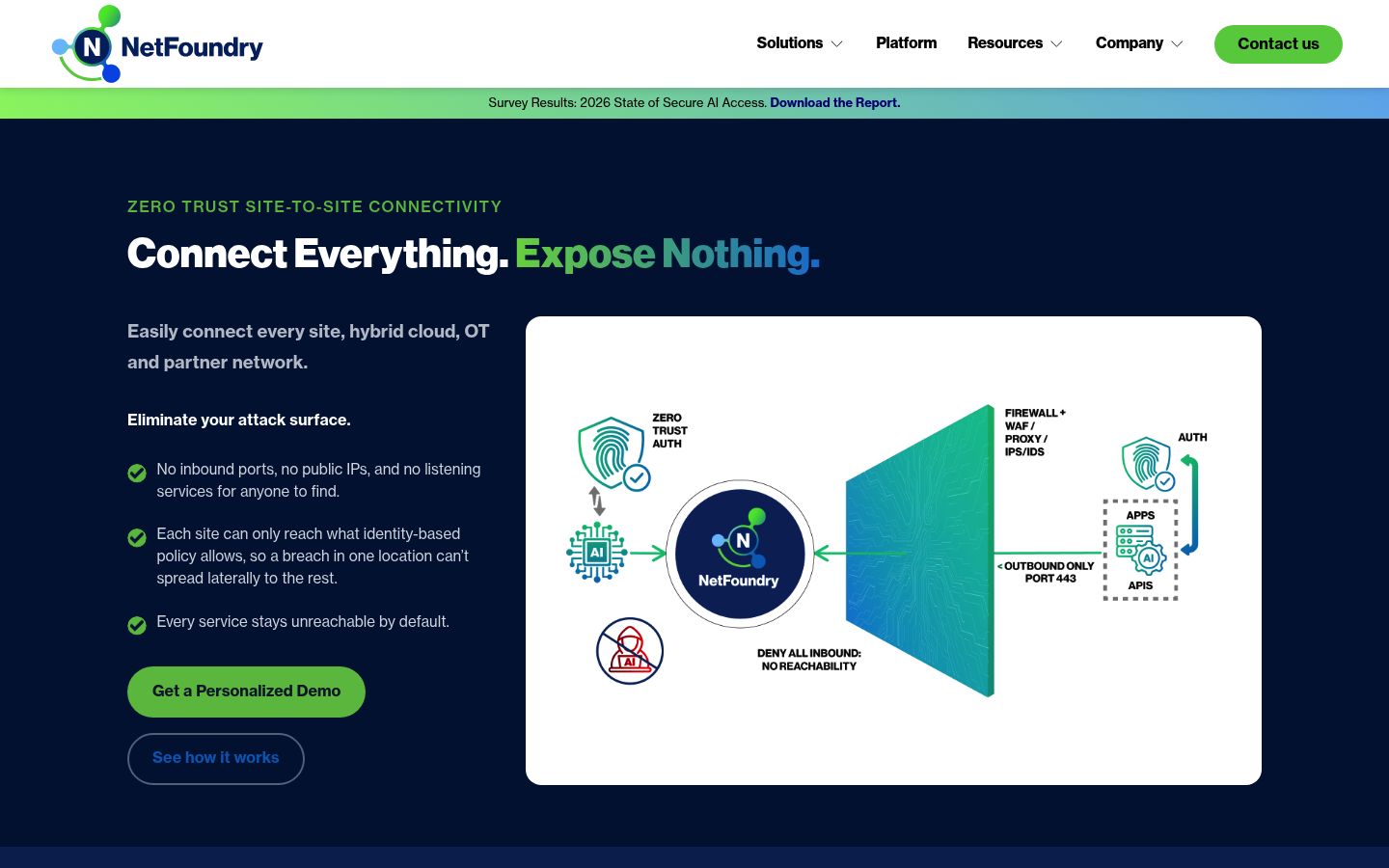
An identity-based overlay is the fastest fit when the goal is to connect sites and clouds without exposing whole networks. The endpoint establishes an outbound path, proves its cryptographic identity, and receives policy for the specific service it may reach.
NetFoundry describes this model for sites, clouds, OT, and partner networks: each service is unreachable by default, and policy authorizes a named identity-to-service connection. Its site-to-site connectivity approach avoids carrier provisioning and inbound firewall openings by using software endpoints that dial out.
Choose an identity-based overlay when you need:
- Site-to-cloud and cloud-to-cloud connectivity under one policy model
- Outbound-only connections with no inbound listening ports
- Service-level access instead of broad subnet reachability
- Identity-based connection logs for operations and audit work
- A path that works across on-premises, cloud, OT, and partner environments
The limitation is equally clear. An overlay does not repair packet loss, poor last-mile capacity, or an underlay that cannot meet the application’s performance target. It changes the trust and reachability model. You still need a reliable path underneath it.
How to choose between MPLS, SD-WAN, and cloud connectivity options
Choose based on the bottleneck you are trying to remove, not on the product category.
| If your main problem is… | Start with… | Why |
|---|---|---|
| New circuits take too long to order | SD-WAN over existing access | Uses links you can obtain now |
| Branch links need active path steering | SD-WAN | Makes underlay selection a policy decision |
| Many workloads live in one cloud | Cloud transit hub | Centralizes cloud routing and attachments |
| Multiple clouds and partner networks must connect | Identity-based overlay | Applies one service policy across heterogeneous sites |
| Broad tunnel access creates lateral-movement risk | Identity-based overlay plus segmentation | Authorizes identities to services, not whole networks |
| A regulated workload needs predictable private transport | MPLS or private interconnect | Keeps a dedicated transport option in the design |
NIST describes zero trust as a move away from implicit trust based on network location. Its SP 800-207 says authentication and authorization should occur before a session to an enterprise resource is established. That principle matters here because faster transport alone does not reduce the blast radius of a connected network.
Microsoft makes the same distinction in its Zero Trust guidance: verify explicitly, use least privilege, and assume breach. Use those principles to evaluate the security boundary of each connectivity option, not just its deployment speed.
A practical migration path from MPLS
The safest MPLS modernization keeps the private circuit while the replacement path proves itself. Start with one site, one cloud workload, or one application dependency. Measure reachability, latency, packet loss, failover, logging, and rollback before moving a wider set of flows.
For teams changing an existing site-to-site design, the site-to-site VPN migration guide covers the parallel-run pattern in more detail. The same operational discipline applies here, but an MPLS project also needs a clear decision about whether the new path is replacing transport, routing, or the trust boundary.
Use this sequence:
- Inventory the circuits, sites, cloud attachments, route tables, and application flows that depend on MPLS.
- Separate transport requirements from access requirements. A database may need a reliable path, but it may not need an entire subnet to be reachable.
- Pick a pilot with a known owner and a reversible cutover.
- Deploy the chosen edge, hub attachment, or software endpoint without removing MPLS.
- Test the application flow and the denied flows around it.
- Compare performance and operating effort with the MPLS baseline.
- Migrate by service group or site, then retire unused routes and contracts only after dependency logs are clean.
The key design decision is whether the new architecture preserves MPLS’s network-level trust model or replaces it with policy at the service boundary. Faster provisioning is useful. Smaller reachability is the stronger security outcome.
FAQ
Why does MPLS provisioning take weeks?
MPLS provisioning takes weeks because it depends on carrier serviceability, local-loop delivery, building access, hardware installation, provider configuration, and testing. A software overlay can remove the physical installation steps, but it still needs an underlay and a controlled deployment process.
What are the best alternatives to MPLS?
The main alternatives to MPLS are SD-WAN over existing access, cloud transit hubs, direct cloud interconnects, and identity-based overlay connectivity. SD-WAN fits branch path control, cloud hubs fit cloud-centric routing, and identity-based overlays fit least-privilege connectivity across sites, clouds, OT, and partners.
Is SD-WAN faster than MPLS?
SD-WAN is usually faster than MPLS when suitable internet or cellular access already exists because it avoids waiting for a new private circuit. It still requires edge deployment, underlay availability, routing design, and operational ownership.
What is the difference between SD-WAN and MPLS?
MPLS is a carrier-provided private transport service, while SD-WAN is an overlay that steers traffic across one or more underlay links. SD-WAN can reduce dependence on private circuits, but it does not automatically provide identity-based, service-level authorization.
How do I connect on-premises sites to multiple clouds?
Use cloud transit hubs for a cloud-centered design, or use an identity-based overlay when the same access policy must span on-premises sites, multiple clouds, OT, and partners. Keep route ownership, failure behavior, and service-level authorization separate in the evaluation.
Can zero trust connectivity replace MPLS?
It can replace MPLS for many application connectivity use cases, but it does not replace the need for a functioning underlay. Test latency, loss, throughput, failover, and application behavior before retiring a private circuit.
Related articles
Sources & References
- NIST Zero Trust Architecture – resource-level authorization principles
- AWS Transit Gateway – cloud hub connectivity model
- Microsoft Zero Trust – verify and least-privilege principles
- NetFoundry Site-to-Site Connectivity – outbound-only identity-based model
- NetFoundry VPN Migration Guide – parallel migration practice