
The best Kong alternatives depend on what you are replacing: API lifecycle management, AI model routing, edge control, or private access to MCP tools. Kong remains a strong API gateway baseline, with a Plus plan from $25 per month plus usage, but Portkey, Cloudflare, Azure API Management, and NetFoundry solve different parts of the AI gateway problem.
For a team replacing Kong, the deciding question is not which product has the longest feature list. It is whether the platform can authorize the right tool, keep private backends unreachable until access is allowed, route model traffic, preserve deployment ownership, and export evidence for an audit.
How to compare Kong alternatives
The order below follows the main replacement reasons in the job brief: AI and MCP policy depth first, private backend reachability second, deployment ownership third, model routing fourth, and published entry pricing last. These are not interchangeable products. Some are API management platforms, some are AI gateways, and one is an identity-first connectivity layer.
| Alternative | Published entry price | Best replacement reason | What you give up versus Kong | Best for |
|---|---|---|---|---|
| NetFoundry | Free forever tier is advertised; paid pricing not published | Identity-first private reachability for agents, APIs, and MCP servers | It is not a full API product catalog or developer portal | Security teams that need authenticate-before-connect access |
| Azure API Management | Not published on the product page; tier-based Azure pricing | Azure-native governance for APIs, models, MCP servers, and agents | Azure ownership and service dependencies are part of the operating model | Enterprises already standardized on Azure |
| Portkey | $49 per month for Production, checked November 3, 2026 | Model routing, fallbacks, logs, budgets, and AI application operations | It is not a drop-in replacement for every traditional API gateway function | AI platform teams managing multiple models |
| Cloudflare AI Gateway | Not published on the product page | Edge routing, caching, rate limits, usage analytics, and unified billing | Cloudflare becomes the control point, and MCP authorization depth needs testing | Teams already operating Cloudflare at the edge |
| Kong | $25 per month plus usage, checked November 3, 2026 | Existing API gateway operations and plugin-based control | It may not provide the private, identity-first reachability a security team wants by itself | Teams already invested in Kong APIs and plugins |
1. NetFoundry: private reachability for AI agents and MCP
NetFoundry is the strongest Kong alternative when the problem is that agents can reach too much network infrastructure. Its MCP Connect page describes outbound-only sessions, cryptographic identity, policy-controlled tool access, and logging of each session with the identity and policy that enabled it.
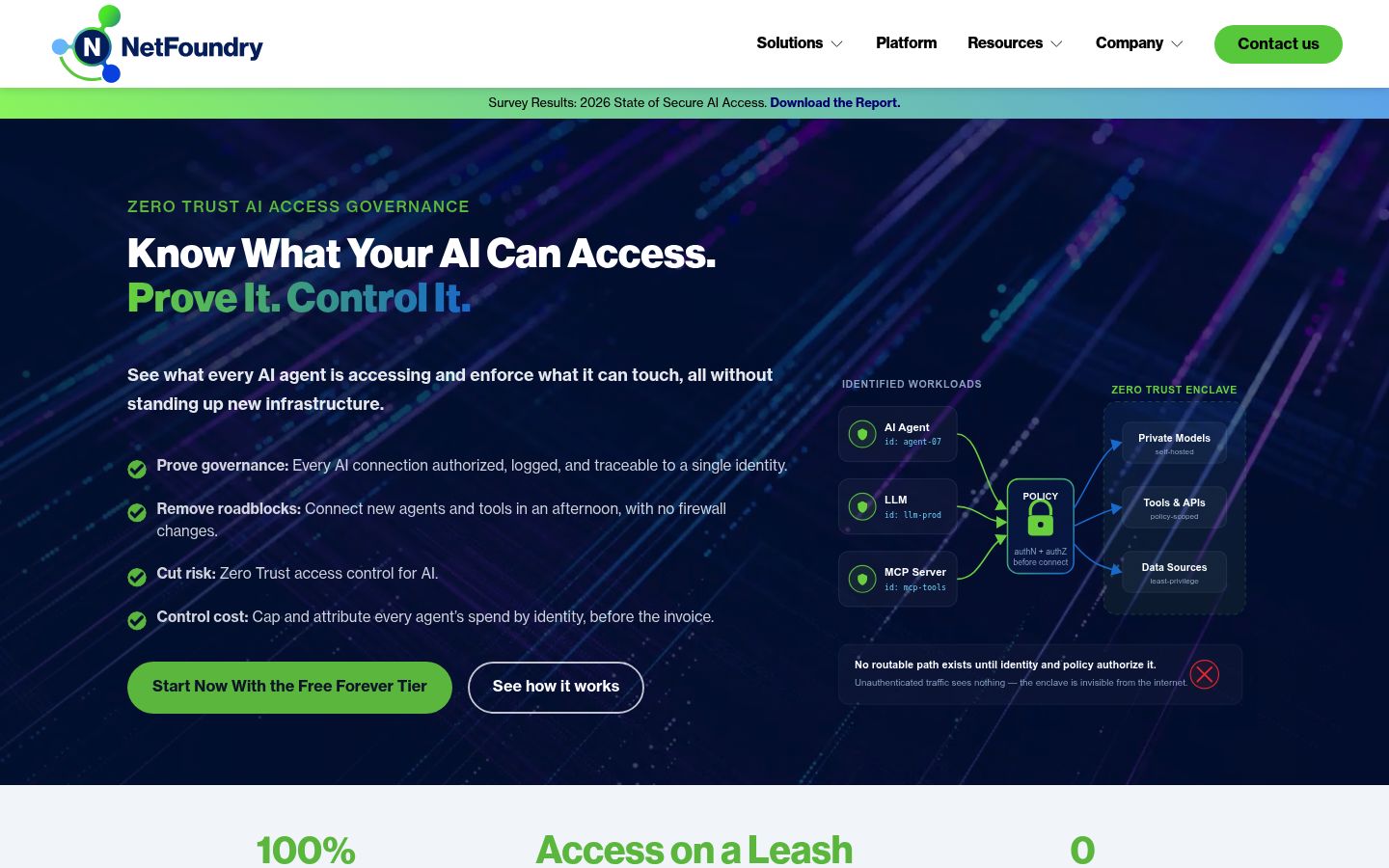
The model is authenticate-before-connect. The agent, user, and machine prove identity first. Policy then decides which MCP server or tool the identity may reach. Only after that decision does an encrypted outbound session open. That changes the security boundary from a reachable API endpoint to a specific identity and service.
NetFoundry also connects this model to OpenZiti, its open source zero trust networking project. OpenZiti supports managed, supported self-hosted, and community self-hosted deployment models. That gives a security architect more control over where the control plane and operational work live than a hosted AI gateway alone.
What it does well: private backend reachability, identity-based microsegmentation, outbound-only connectivity, and session evidence.
Limitation: NetFoundry is not a traditional API management suite. Its public pages do not present a Kong-style developer portal, API catalog, or a public paid rate card. Treat it as the connectivity and authorization layer, not as a complete API lifecycle replacement.
Best for: CISOs and platform engineers who need AI agents to reach private systems without opening inbound ports.
2. Azure API Management: the Azure-native replacement
Azure API Management is the best Kong alternative for an enterprise that already runs its identity, networking, models, and compliance controls in Azure. Microsoft documents support for traditional APIs, models, MCP servers, and agents in one management platform.
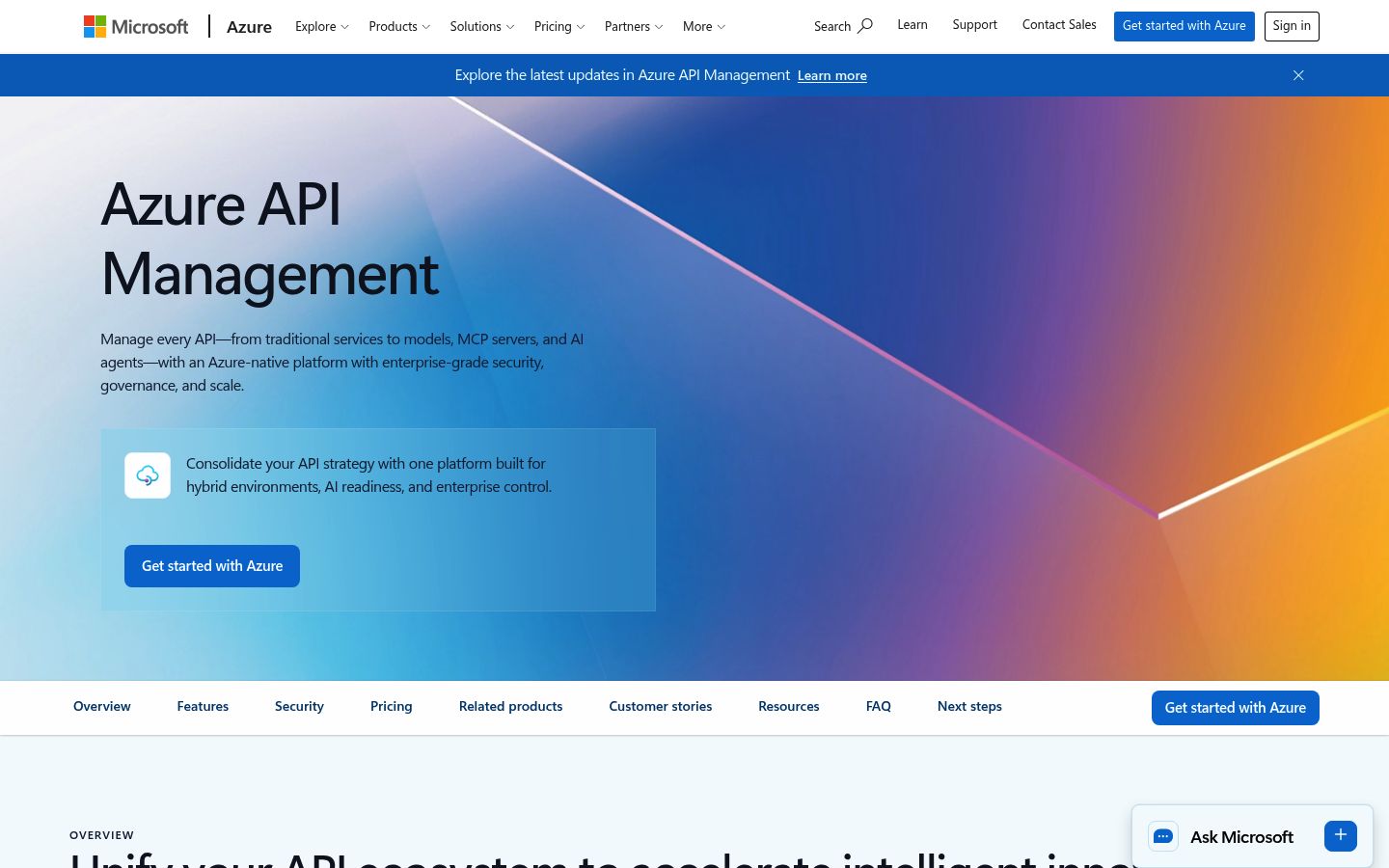
Azure’s current product page lists authentication, authorization, rate limits, quotas, transformations, semantic caching, token tracking, content safety, and model load balancing. It also says that existing REST APIs can be exposed as MCP servers and governed with authentication, authorization, and rate-limit policies.
The deployment story is broad. Microsoft documents self-hosted gateways for Azure, on-premises environments, and other clouds, with a central Azure control plane. That is useful when the team wants distributed runtimes but accepts Azure as the policy and inventory center.
What it does well: API lifecycle governance, MCP enablement, Azure integration, hybrid gateways, and centralized policy.
Limitation: Microsoft does not publish a single entry price on the product page. Its pricing page describes Developer, Standard, and Premium tiers, so you need a workload-specific estimate before comparing total cost with Kong Plus or Portkey Production.
Best for: enterprise teams that want one Azure-native control plane for APIs, models, MCP servers, and agents.
3. Portkey: model routing and AI application operations
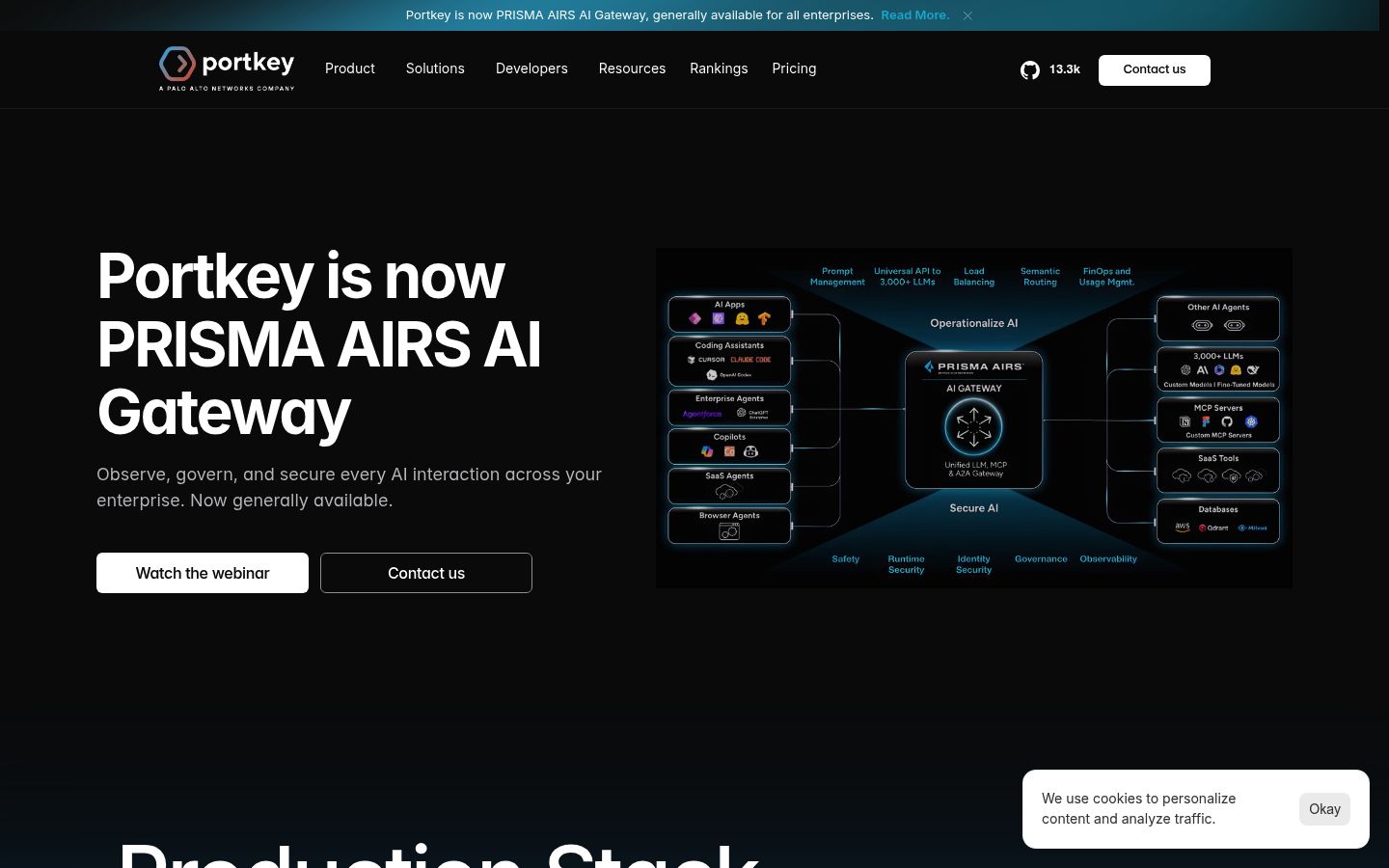
Portkey is the best Kong alternative when the main requirement is operating model traffic rather than exposing a large traditional API estate. Its AI Gateway documentation lists a universal API, fallbacks, conditional routing, retries, circuit breakers, load balancing, caching, budget limits, rate limits, and private model hosts.
Portkey publishes a Production plan at $49 per month, checked November 3, 2026. The same page lists 100,000 recorded logs per month and $9 overages for each additional 100,000 requests. It also describes an Enterprise plan with custom pricing, private cloud deployment, VPC hosting, data export to data lakes, SSO, granular budgets, and custom retention.
That makes Portkey a practical fit for teams that need to switch between model providers without rewriting application code. The tradeoff is scope. Portkey’s public material centers on AI Gateway and observability features, not the full API portal, API catalog, and general-purpose gateway operations that may already anchor a Kong deployment.
What it does well: LLM routing, fallback behavior, model-provider abstraction, prompt and request observability, and budget controls.
Limitation: the $49 plan is not a complete enterprise security boundary. Portkey’s pricing page says that custom security controls and data residency guarantees belong in the enterprise conversation.
Best for: AI platform teams with several model providers, changing routing rules, and a need to attribute model usage by team or application.
4. Cloudflare AI Gateway: edge control with caching and analytics
Cloudflare AI Gateway fits teams that already operate at Cloudflare’s edge and want a unified way to connect to model providers. Cloudflare describes multi-provider support, response caching, fallback routing, rate limiting, token counting, usage analytics, and unified billing.
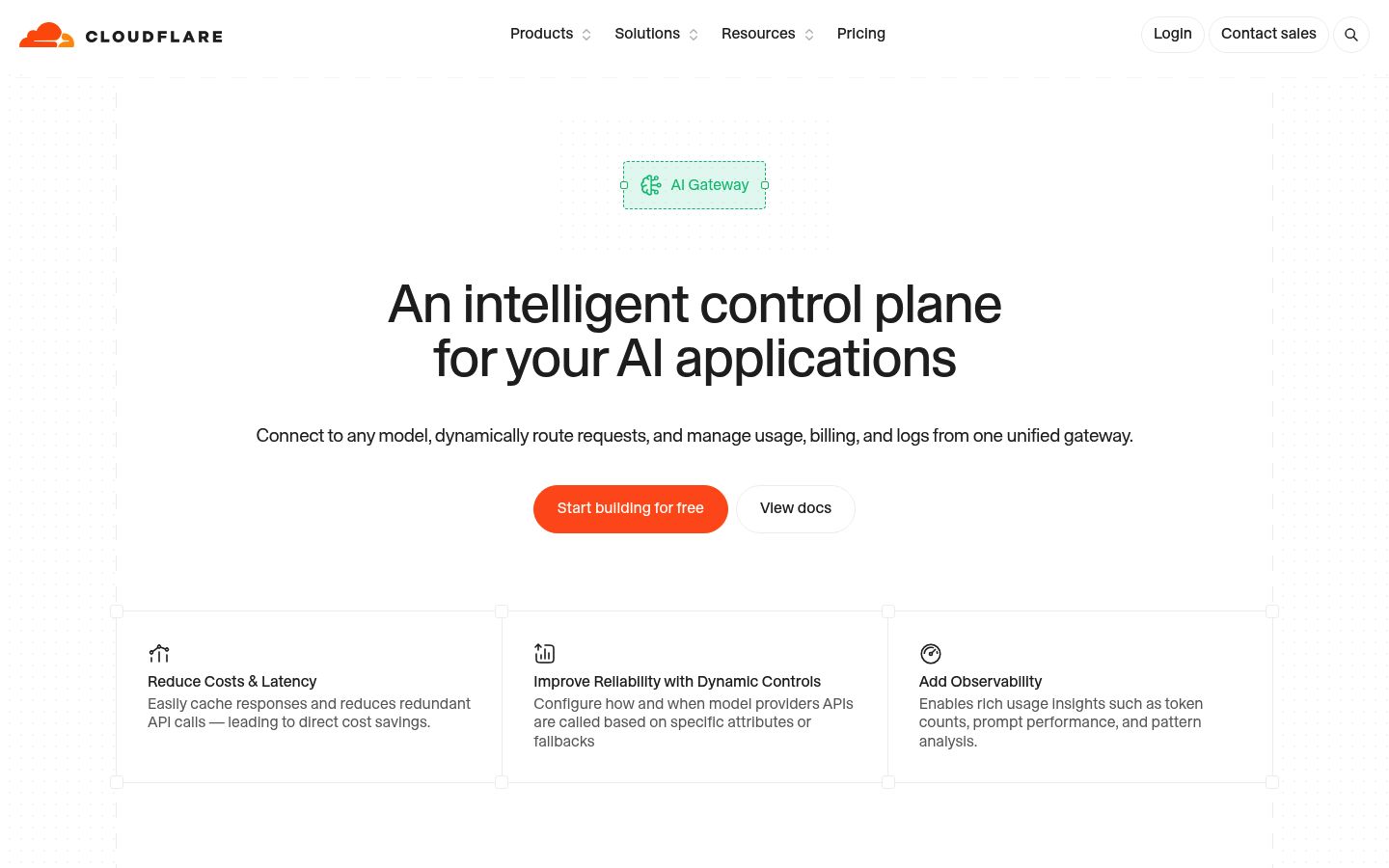
The product’s center of gravity is traffic control for AI applications. Caching can reduce repeated provider calls. Fallbacks can change the provider used when a route fails. Logs and token counts help teams track prompt behavior and usage across providers.
What it does well: edge deployment, caching, provider failover, rate controls, and usage visibility.
Limitation: the product page does not publish an entry price. It also does not document the same identity-first MCP reachability model described by NetFoundry. Before choosing it for agent access to private tools, test tool authorization, private backend connectivity, audit export, and the exact Cloudflare products required.
Best for: engineering teams already using Cloudflare Workers, routing, and security services that want AI traffic controls in the same edge environment.
5. Kong: stay when API operations are the real requirement
Kong Gateway is the right answer when the reason for leaving has not been separated from the product itself. Kong documents an open source gateway, Enterprise capabilities, Konnect control planes, declarative configuration, Kubernetes support, plugins, and deployment across on-premises, cloud, Kubernetes, and serverless environments.
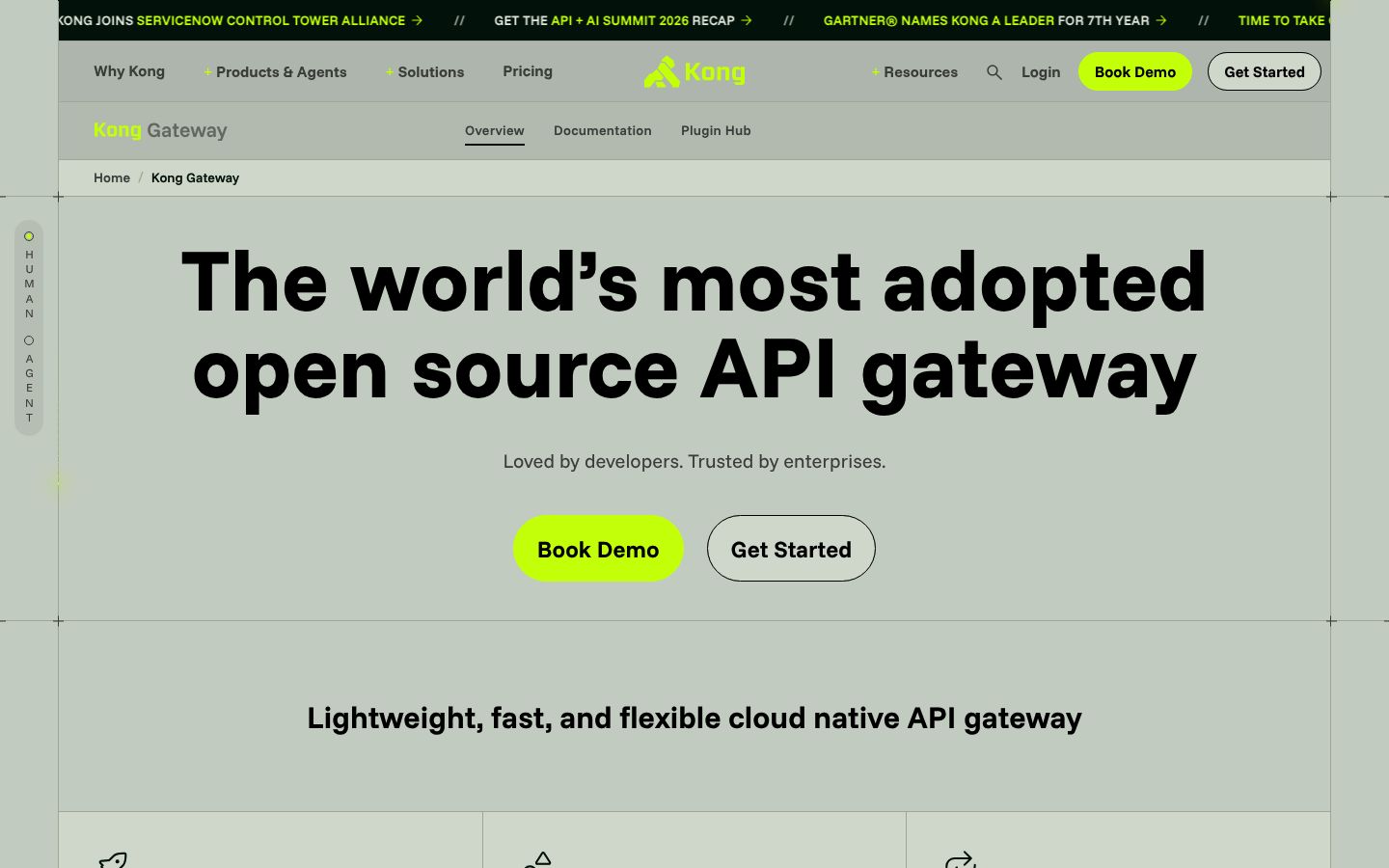
Kong’s public pricing page lists AI and API Management Plus from $25 per month plus usage, checked November 3, 2026. The page also lists one million included requests per month, with $200 per additional million requests per month for the API Management Plus comparison. Enterprise pricing is custom. Dedicated cloud gateway control planes and hybrid gateways have separate costs.
Kong’s documented strengths include plugin-based authentication, transformations, analytics, GitOps-style configuration, and Kubernetes-native operation. Kong also advertises 50K-plus transactions per second per node on its gateway product page, though a buyer should validate that figure against its own routes, plugins, payloads, and deployment.
What it does well: broad API gateway coverage, deployment flexibility, plugins, declarative operations, and an established API management model.
Limitation: choosing Kong alone does not prove that an agent can access only an approved MCP tool or that a private backend is unreachable before authorization. Those controls need to be demonstrated in the edition and architecture you will deploy.
Best for: teams whose core problem is managing APIs and who want to extend that platform toward AI traffic without replacing their operating model.
Which Kong alternative should you choose?
Choose NetFoundry when private reachability and identity-first policy are the first gate. Choose Azure API Management when Azure is already the enterprise control plane. Choose Portkey when model routing, fallbacks, and AI usage operations matter more than broad API lifecycle management.
Choose Cloudflare when edge proximity, caching, and existing Cloudflare operations matter. Stay with Kong when its API gateway and plugin model already meet the requirement and the AI controls pass a real proof of concept.
The proof of concept should test five paths, not five marketing checkboxes:
- An identified agent discovers only the MCP tools its policy allows.
- A denied tool call produces a useful policy event.
- A private backend has no reachable inbound path before authorization.
- A model failure routes to the approved fallback without losing identity or audit context.
- The security team can export the evidence it needs without joining unrelated log systems by hand.
Frequently asked questions
What are the best Kong alternatives for AI gateways?
NetFoundry, Azure API Management, Portkey, and Cloudflare AI Gateway are the clearest alternatives for the AI gateway use cases in this comparison. They differ in emphasis: private reachability, Azure governance, model operations, and edge traffic control. The right choice depends on which control must be proved first in your architecture.
Which Kong alternative is best for MCP tool authorization?
NetFoundry is the most directly aligned with identity-based MCP reachability in the public material reviewed here. Azure API Management also documents MCP server governance with authentication, authorization, rate limits, and a private tool registry. Test both products with a denied tool call and an audit export before treating the feature as production-ready.
Which Kong alternative supports model routing and fallbacks?
Portkey documents conditional routing, fallbacks, retries, circuit breakers, and load balancing. Cloudflare AI Gateway documents dynamic routing and fallback controls, while Azure documents load balancing across models. The important test is whether the fallback preserves the identity, policy decision, and trace context your review process needs.
Is there a cheaper alternative to Kong?
There is no fair answer without a workload and deployment model. Kong Plus publishes a $25 monthly starting price, Portkey Production publishes $49 per month, and the public pages reviewed here do not publish a comparable entry price for Cloudflare, Azure API Management, or paid NetFoundry service.
Compare request volume, control plane count, data retention, support, and the cost of operating private gateways.
Can Azure API Management replace Kong in a hybrid environment?
Azure documents self-hosted gateways for Azure, on-premises, and other clouds with centralized policy and observability. Whether it replaces Kong cleanly depends on your existing gateway configuration, plugins, identity integration, and migration requirements. A migration plan should inventory routes, plugins, certificates, policies, consumers, and rollback steps before production cutover.
Does NetFoundry replace an API gateway?
NetFoundry replaces the network reachability and identity boundary, not every API management function. Keep a separate API gateway when you need a developer portal, API catalog, transformation plugins, or broad API lifecycle workflows that NetFoundry’s public pages do not claim to provide. Its value is strongest when the gateway must protect private services rather than simply proxy public endpoints.
Sources & References
- Kong pricing, checked November 3, 2026: Kong Plus pricing and usage limits.
- Kong Gateway, checked November 3, 2026: deployment, plugins, Kubernetes, and throughput claim.
- Portkey pricing, checked November 3, 2026: Production price, logs, overages, and Enterprise controls.
- Portkey AI Gateway documentation, checked November 3, 2026: routing, fallbacks, caching, limits, and MCP support.
- Cloudflare AI Gateway, checked November 3, 2026: edge AI gateway capabilities.
- Azure API Management, checked November 3, 2026: AI, MCP, hybrid gateway, and pricing tier descriptions.
- NetFoundry AI security, checked November 3, 2026: identity-first access, MCP reachability, and private connectivity.
- OpenZiti, checked November 3, 2026: self-hosted and managed deployment models.