
At A Glance
- CVE-2026-98432 is a use-after-free in the Linux kernel’s IPv4 TCP handshake, scored 9.8 out of 10 by the kernel maintainers, with potential for unauthenticated remote code execution as root.
- The hosts most exposed to a Linux kernel flaw are the same hosts running modern AI: GPU training nodes, model-serving endpoints, and the MCP servers that connect models to tools and data.
- Every remote exploit needs one thing first: a reachable listening port. Patching is essential, but it always lags disclosure.
- An identity-based overlay removes the public listener entirely, so an unauthenticated scanner never reaches the port the exploit depends on.
A Kernel Flaw Meets the AI Boom
On October 15, 2026, the Linux kernel team published CVE-2026-98432, a use-after-free in the IPv4 TCP handshake that the maintainers scored 9.8 out of 10. An unauthenticated attacker who can send packets to a listening TCP port may be able to run code as root. One detail turned heads: an Anthropic researcher reported the flaw, and Anthropic says one of its unreleased models wrote a working exploit chain after some initial prompting. Whether or not that chain shows up in public, the arithmetic is uncomfortable, because the machines most exposed to a Linux kernel bug are the same machines now carrying the AI boom.
The AI World Lives on Linux
Linux is not a slice of AI infrastructure. It is the floor the whole thing stands on. W3Techs puts Linux at 63.3% of all websites whose operating system is known, and every one of the world’s 500 fastest supercomputers runs a Linux variant. NVIDIA’s data center GPUs, the CUDA toolkit, and the DGX systems that train frontier models are Linux-first by design. PyTorch, the container images teams pull from public model hubs, and the orchestration layers beneath them all assume a Linux host.
Model Context Protocol servers sit squarely in that pattern. The reference SDKs ship in TypeScript and Python, and teams package them as containers that land on a Linux host in production. An MCP server’s job is to sit between a model and a tool, a database, or an internal API, which means it listens on a network port and waits for connections. That is the exact shape of system CVE-2026-98432 puts at risk: a Linux host with something listening on TCP.
What CVE-2026-98432 Actually Does
The bug lives in how the kernel handles the TCP three-way handshake. When a connection request carries certain IPv4 options, the kernel attaches them to a half-open socket and then hands them to the finished connection without making its own copy. A retransmitted request processed on a second CPU core can read that memory after the kernel has freed it. The code path has been present since Linux 4.4 in 2016, and the upstream fix landed on October 5, 2026.
Patch status is uneven as of early November. Debian, Oracle’s UEK kernels, SUSE, and most Amazon Linux builds have fixes. Red Hat Enterprise Linux 8, 9, and 10, along with their rebuilds, were still waiting on production kernels, and Ubuntu’s fixes were in progress. If your AI workloads run on RHEL-family or Ubuntu hosts, check the running kernel with uname -r against your distribution’s fixed version rather than assuming the upstream number applies.
Reachability Is the Real Exposure
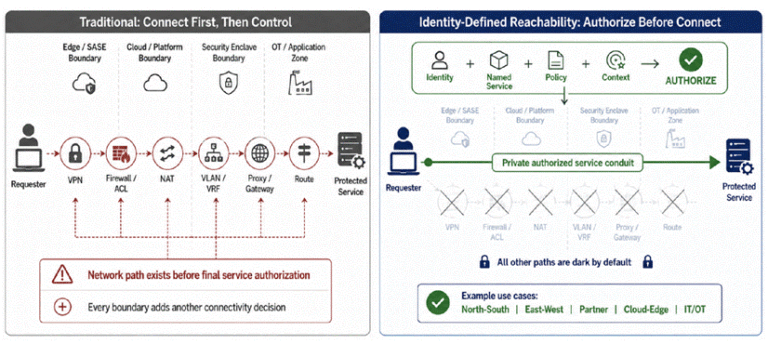
Every remote exploit, this one included, depends on one precondition: the attacker can reach the vulnerable port. CVE-2026-98432 needs a crafted TCP handshake delivered to something that is listening. No reachable listener, no remote attack. If you can’t patch a host the instant a fix ships, and most teams can’t, because reboots mean downtime, the next best control is making sure the only parties who can open a connection to that host are the ones you have already authorized.
That is a different question from “is the kernel patched.” It is “who can even get a packet to this port in the first place.” Public IP addresses, open inbound firewall rules, and flat internal networks all answer that question the wrong way. An attacker scanning for listening MCP servers or model-serving endpoints finds them precisely because those services are reachable by default.
Give a Remote Attacker Nothing to Knock On
NetFoundry takes the reachable surface off the table. Services connect through an identity-based overlay, so an MCP server, a model endpoint, or a training host has no public listener at all. Connections start outbound, and NetFoundry authorizes them by cryptographic identity and mutual TLS before any traffic flows, which means an unauthenticated scanner never reaches the port CVE-2026-98432 depends on. The vulnerability can still sit in the kernel, but the path an attacker would use to trigger it remotely is gone.
That principle holds well beyond one CVE. If you can’t control the agent, you have to control what it can reach, and the inverse matters just as much: control what can reach the agent. NetFoundry’s MCP and LLM gateways are available when you want model-aware controls in the same fabric, though they are optional. The core protection here is simpler, and it is giving your Linux AI hosts nothing for a remote attacker to find.
See how NetFoundry secures AI infrastructure.
Talk to us about closing your inbound attack surface.
Frequently Asked Questions
Does patching the kernel make NetFoundry unnecessary?
Patch, and patch promptly. But patches lag disclosure, reboots cause downtime, and the next kernel CVE is already on its way. Removing public reachability protects the host during the window before a patch ships, and against the flaws nobody has found yet.
Is this only an MCP server problem?
No. Any Linux host with a listening TCP service is in scope, including model-serving endpoints, vector databases, orchestration APIs, and training nodes. MCP servers are a clear example because they exist to listen for connections.
Has CVE-2026-98432 been exploited in the wild?
As of early November 2026, no public proof-of-concept and no confirmed in-the-wild exploitation had been reported, and the flaw was not on CISA’s Known Exploited Vulnerabilities list. The concern is the 9.8 severity and the claimed model-written exploit, not a known active campaign.
Do I need NetFoundry’s MCP or LLM gateway to get this protection?
No. The reachability protection comes from the overlay itself. The MCP and LLM gateways are optional components for teams that want model-aware policy in the same fabric.