

At A Glance
- The study: We read installation guides from 480 software and hardware vendors across 25 categories and recorded 537 network requirements, quoted word for word.
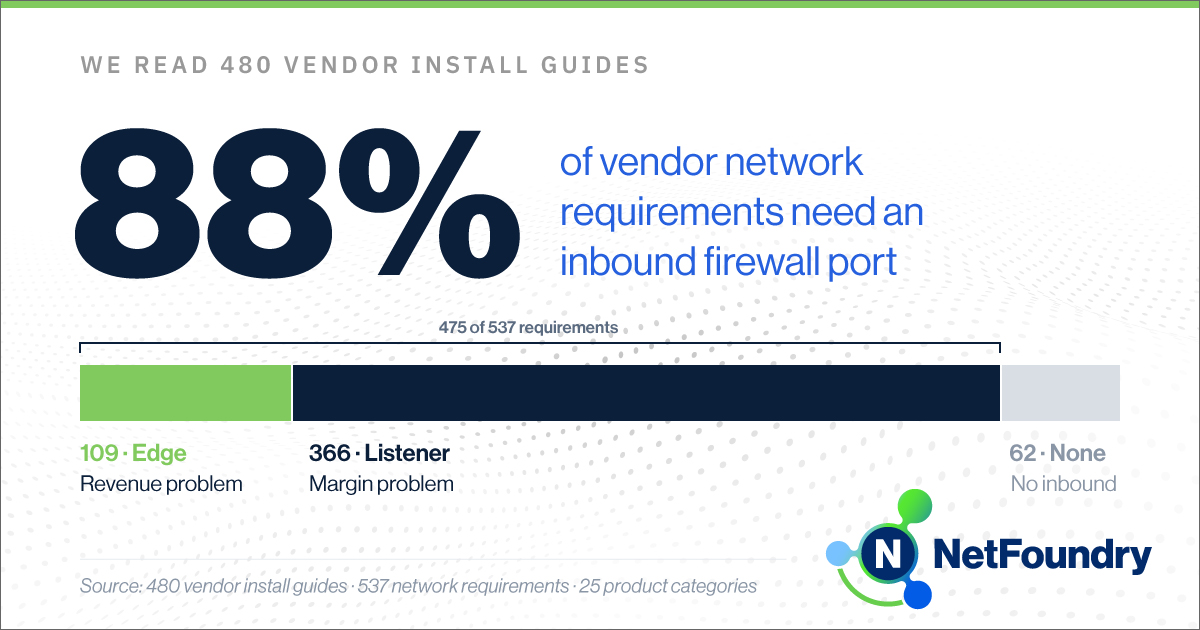
- The headline: 475 of those requirements (88%) need inbound traffic through a firewall before the product works.
- Problem one, the edge (109 requirements): Customers must change their internet-facing firewall. That triggers security review and change boards, delays go-live by weeks, and becomes a revenue problem.
- Problem two, the listener (366 requirements): Customers must let every client reach a server or license daemon inside the network. It’s quick to set up but recurs on every deployment and in support tickets, so it’s a margin problem.
- What’s changed: 97 vendors now say their product needs no inbound access at all, so the network step is now a product decision competitors are already making.
We read the installation guides of 480 software and hardware vendors and pulled out every network requirement. 88% of those requirements tell customers to open an inbound path through a firewall before the product works.
That number is striking, but it hides something more useful. “Requires an inbound port” is really two different problems. They hurt different people, show up in different parts of the business, and need different conversations. Treating them as one is why the conversation usually goes nowhere.
How we did the research
Across 25 product categories, we recorded 537 network requirements. Each one is quoted word for word from the vendor’s own documentation, not inferred or paraphrased.
Of those 537 requirements, 475 require inbound traffic through a firewall. When we sorted them by where the inbound path lands, they split cleanly into two groups.
| Problem one: the edge | Problem two: the listener | |
|---|---|---|
| What the customer must do | Change the internet-facing firewall: port forward, NAT rule, public IP or DMZ server | Allow clients to reach a server or license daemon inside the network |
| Requirements | 109 | 366 |
| Vendors | 108 | 334 |
| Who handles it | Security review and change board | IT admin |
| How long it takes | Weeks | About an hour, on every deployment |
| Business impact | Revenue | Margin |
| Who owns the pain | VP of Product, GM, CRO | Product and customer success |
Problem one: a change at the customer’s edge
109 requirements, from 108 companies, ask the customer to change the internet-facing firewall. That means a port forward, a NAT rule, a public IP or a server in the DMZ.
The team that bought your product can’t make that change. It goes to security review, then a change board and, in regulated industries, a documented exception. The deal is signed, but go-live slides by weeks while a ticket you can’t see moves through a queue you can’t influence.
That’s a revenue problem. It rarely shows up in the CRM under its real name. Instead it gets logged as “slow”, “no decision” or “lost to competitor”.
Problem two: a listener inside the network
366 requirements, from 334 companies, run a server or license daemon inside the customer’s network that every client must reach.
This lands on an IT admin, not a CISO, and it takes an hour, not a month. But it happens on every deployment, forever. Then a rule changes, a server moves or an update resets the firewall, and it comes back as a support ticket.
That’s a margin problem. It hides in implementation hours, support queues and engineering time spent on plumbing instead of product.
Why the distinction matters
I’ve watched good sellers pitch the revenue argument to companies with the margin problem, and vice versa. Neither lands, because the pain lives with a different person.
- The edge problem belongs to whoever owns the number: VP of Product, GM, CRO.
- The listener problem belongs to whoever owns the cost of each install: product and customer success.
Neither belongs to the network team. The requirement was written years ago and was reasonable then, but nobody has revisited it. The real question is whether it still makes sense as a product decision.
What has changed
97 companies now state in their docs that their product needs no inbound access at all. In backup, physical security and clinical practice software, vendors that need inbound access and vendors that don’t now compete in the same buying decision.
The network step used to be a fact of the category. Now it’s a product decision your competitors are already making.
What’s next in this series
Over the next few weeks, we’ll look at specific markets where the inbound requirement shapes how products are bought and supported:
- Plant-floor and industrial systems
- Clinical and healthcare software
- Regulated buyers
- Hosted AI
- Remote instrument service
- Building systems
- Licensing
Frequently asked questions
Why do so many products require an inbound firewall port?
Most of these requirements were written years ago, when opening a port or running an on-premises listener was the standard way to connect. They were reasonable then, but few vendors have revisited them since.
What’s the difference between an edge requirement and an internal listener?
An edge requirement asks the customer to change the internet-facing firewall: a port forward, NAT rule, public IP or DMZ server. An internal listener is a server or license daemon inside the customer’s network that every client must reach. In our research, 109 requirements were edge changes and 366 were internal listeners.
How does an inbound port requirement slow down sales?
Edge changes go through security review, a change board and, in regulated industries, a documented exception. Go-live can slip by weeks after the contract is signed. In the CRM, these deals are often logged as “slow”, “no decision” or “lost to competitor”.
How does an internal listener affect margins?
Each deployment needs an IT admin to configure network access, and the setup breaks when rules change, servers move or updates reset the firewall. That cost shows up in implementation hours, support tickets and engineering time.
Who should own the inbound port decision?
Not the network team. The edge problem belongs to whoever owns revenue, such as the VP of Product, GM or CRO. The listener problem belongs to whoever owns the cost of each install, usually product and customer success.
Can a product work without any inbound ports?
Yes. 97 companies in our study state that their product needs no inbound access at all. Approaches like zero trust networking with outbound-only connections, which NetFoundry provides, let products connect without the customer opening a firewall port.
One question for your next pipeline review
Of the deals you lost or delayed last year, how many stalled after you’d already won technically?
If the answer is more than a few, the network step may be costing you more than you think. NetFoundry helps software and hardware vendors build zero trust, outbound-only connectivity into their products, so customers never have to open an inbound port. Talk to us about taking the firewall ticket out of your deployment.