
A vendor security assessment for MCP and LLM gateways should test identity, tool authorization, telemetry, isolation, and operational ownership with evidence.
Vendor security assessment for MCP and LLM gateway vendors should end with evidence, not a feature checklist. Ask each vendor to prove five controls: workload identity, tool-level authorization, useful telemetry, isolation under failure, and operational ownership. Then run the same two-agent test against Kong, Portkey, and NetFoundry.
The right choice depends on the boundary you need to control. Kong fits teams extending an existing API and AI gateway estate. Portkey fits teams centered on model routing, provider resilience, and LLM observability.
NetFoundry fits enterprise security and infrastructure teams that need identity-first reachability across agents, MCP servers, models, APIs, and private workloads. Those are different products solving overlapping parts of the problem, so compare them against the same failure tests.
NetFoundry is the company behind one of the options below. Treat its product statements as vendor claims and require the same proof from all three vendors.
What should a CISO test first?
A CISO should test whether a vendor can identify the calling workload, authorize the exact action, record the decision, and prevent access outside the approved boundary. A gateway that only authenticates a connection leaves the hardest security questions unanswered.
Use this evidence request in the first vendor meeting:
- Show one identity for a read-only agent and a different identity for an operator agent.
- Hide a write tool from the read-only agent during tool discovery.
- Submit a forged request for that write tool and show the denial.
- Expire or revoke one identity, then show that its next connection fails.
- Reconstruct both attempts from exported logs without vendor interpretation.
This is a procurement field test. It turns the AI agent governance scorecard into acceptance criteria instead of leaving it as policy language.
Why the gateway boundary matters
An LLM gateway governs requests to model providers. An MCP gateway governs how an agent discovers and invokes tools. Some products cover both, but the controls are not interchangeable.
The MCP authorization specification defines transport-level authorization for HTTP-based MCP servers. It requires resource metadata and token validation when authorization is supported, including validation that a token was issued for the intended MCP server. It does not give a buyer a complete per-tool policy model.
Ask where each control is enforced:
| Control | LLM gateway question | MCP gateway question | Pass condition |
|---|---|---|---|
| Identity | Can the gateway distinguish applications, teams, and workloads? | Can it distinguish agents, versions, and sessions? | A shared API key is not the only principal identifier. |
| Authorization | Can policy limit models, providers, prompts, and budgets? | Can policy limit tool discovery and invocation? | A denied tool is absent or rejected before backend access. |
| Telemetry | Are model, provider, tokens, errors, and latency correlated? | Are agent, tool, backend, decision, and result correlated? | Security can export a complete request trail. |
| Isolation | Can private model endpoints stay unreachable to unauthorized workloads? | Can an agent reach only approved MCP servers and backends? | A compromised agent cannot use a broad network path. |
| Operations | Can teams version, review, and roll back policy? | Can they revoke identity and change tool access quickly? | The change is tested and visible in audit records. |
The pass condition is behavioral. A product page can say “MCP support” and still leave tool authorization to application code.
The five evidence requests that decide the review
1. Prove machine identity
The first question is not whether the vendor supports OAuth. It is whether the system can tell one agent from another and bind that identity to a real workload.
Request the identity issuance, renewal, expiry, and revocation flow. Ask how the identity records its owner, environment, version, and deployment. A token that says only “the application” is too broad for incident response.
The NIST Zero Trust Architecture rejects implicit trust based on network location. Your test should do the same. Start with an agent identity, then authorize a connection. Do not start with a reachable endpoint and filter the request later.
2. Test tool-level policy
The second question is whether the gateway controls a named tool and its arguments, not just the route to an MCP server.
Use a harmless read tool and a state-changing tool. Give the read-only agent access to the first one. The write tool should be absent from discovery, and a direct forged call should fail if the agent submits it anyway.
Ask whether policy can use agent identity, human initiator, environment, role, data sensitivity, destination, and operation risk. If the answer is only “we can configure an allowlist,” ask where that allowlist lives, how it is reviewed, and how a policy change reaches production.
An MCP gateway can reduce prompt injection impact by narrowing the tools an agent can discover. It cannot decide whether every model instruction is trustworthy. The MCP server still needs input validation, backend authorization, and its own audit events.
3. Inspect the audit trail
The third question is whether a security analyst can reconstruct an action from identity to result.
Request a raw export, not a dashboard tour. It should connect the agent identity, human initiator when applicable, model or session, MCP server, tool name, requested operation, policy decision, destination, response status, and credential events.
Run one allowed call, one denied call, and one revoked-identity call. Ask the vendor to correlate them without manually joining unrelated logs. If the product records only provider usage or gateway status, it is not enough for an agent incident review.
The OWASP AI Agent Security Cheat Sheet is a useful source for turning identity, authorization, tool use, and monitoring concerns into concrete review questions.
4. Break the network path
The fourth question is what an agent can reach after compromise.
Run the test with a development agent and a production agent. Attempt to discover an unrelated service, reuse one identity as the other, reach a production backend from development, and connect directly to an MCP server outside policy.
The expected result is not just an HTTP denial. An unauthorized workload should not receive a usable path to the service. That is the practical meaning of microsegmentation in an agent environment.
NetFoundry describes this as authenticate-before-connect and Identity-First Reachability™. Its model uses identity and policy before a service path exists. Whether you select that model or another one, require the same failure test.
5. Inspect the operating model
The fifth question is who owns policy after deployment.
Ask how teams review changes, separate development from production, rotate provider credentials, revoke an agent, export records, and restore a known-good policy. Ask for the deployment model, data handling terms, support boundary, and the controls available in the edition you would buy.
Public pricing is not enough for this decision. Record what the vendor does not publish and put it in the commercial diligence list. The absence of a public price is not a security failure, but an undocumented control is an evaluation gap.
How Kong, Portkey, and NetFoundry differ
The following comparison uses public product and documentation pages checked on November 3, 2026. It describes documented capability, not a hands-on test. A “partial” result means the public material describes a useful control but does not prove the full CISO acceptance test.
| Vendor | Documented fit | Strongest evidence request | Main limitation to test |
|---|---|---|---|
| Kong AI Gateway | Unified governance for LLM, MCP, and agent traffic | Show MCP tool discovery, OAuth scope, logs, and policy-as-code in the deployed edition | Product pages do not prove every per-agent and per-tool rule in your environment |
| Portkey AI Gateway | Model routing, fallbacks, budgets, guardrails, and remote MCP connectivity | Show how agent identity and MCP tool decisions appear beside model request logs | Public docs emphasize LLM gateway operations more than dedicated MCP tool authorization |
| NetFoundry AI Security | Identity-first reachability for agents, models, MCP servers, APIs, and private workloads | Show identity issuance, tool filtering, revocation, and unreachable unauthorized backends | Product details, plan boundaries, and pricing require vendor confirmation |
Kong: the existing gateway estate option
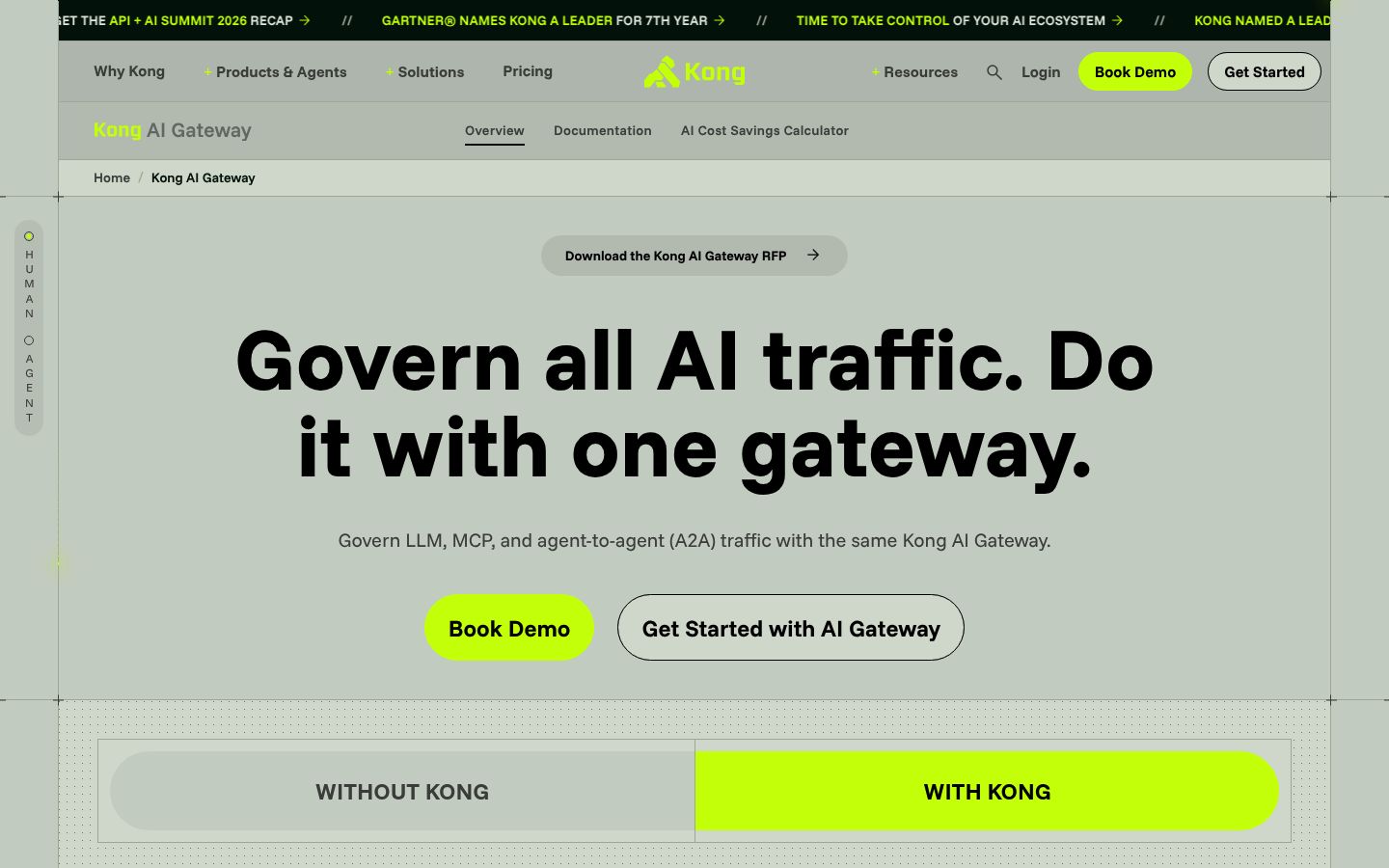
Kong AI Gateway documents one control plane for LLM, MCP, and agent-to-agent traffic. Its public page describes MCP server generation, MCP access authentication, context optimization, prompt guards, PII sanitization, quotas, usage tracking, logging, and tracing.
Kong is the strongest starting point for a team that already operates Kong and wants to extend familiar API governance into AI traffic. The documentation also describes a unified API interface for multiple providers and a self-hosted data plane option through Kong AI Gateway documentation.
Best for: platform teams with an existing Kong operating model and a requirement to manage API and AI traffic together.
Limitation: the product page does not by itself prove that your chosen edition can hide individual MCP tools per agent, bind every call to a workload identity, or isolate a backend from direct access. Put those tests in the proof of concept.
Pass test: create two agents, attach different OAuth scopes, and show that discovery, invocation, and exported audit records reflect the difference.
Portkey: the model operations option
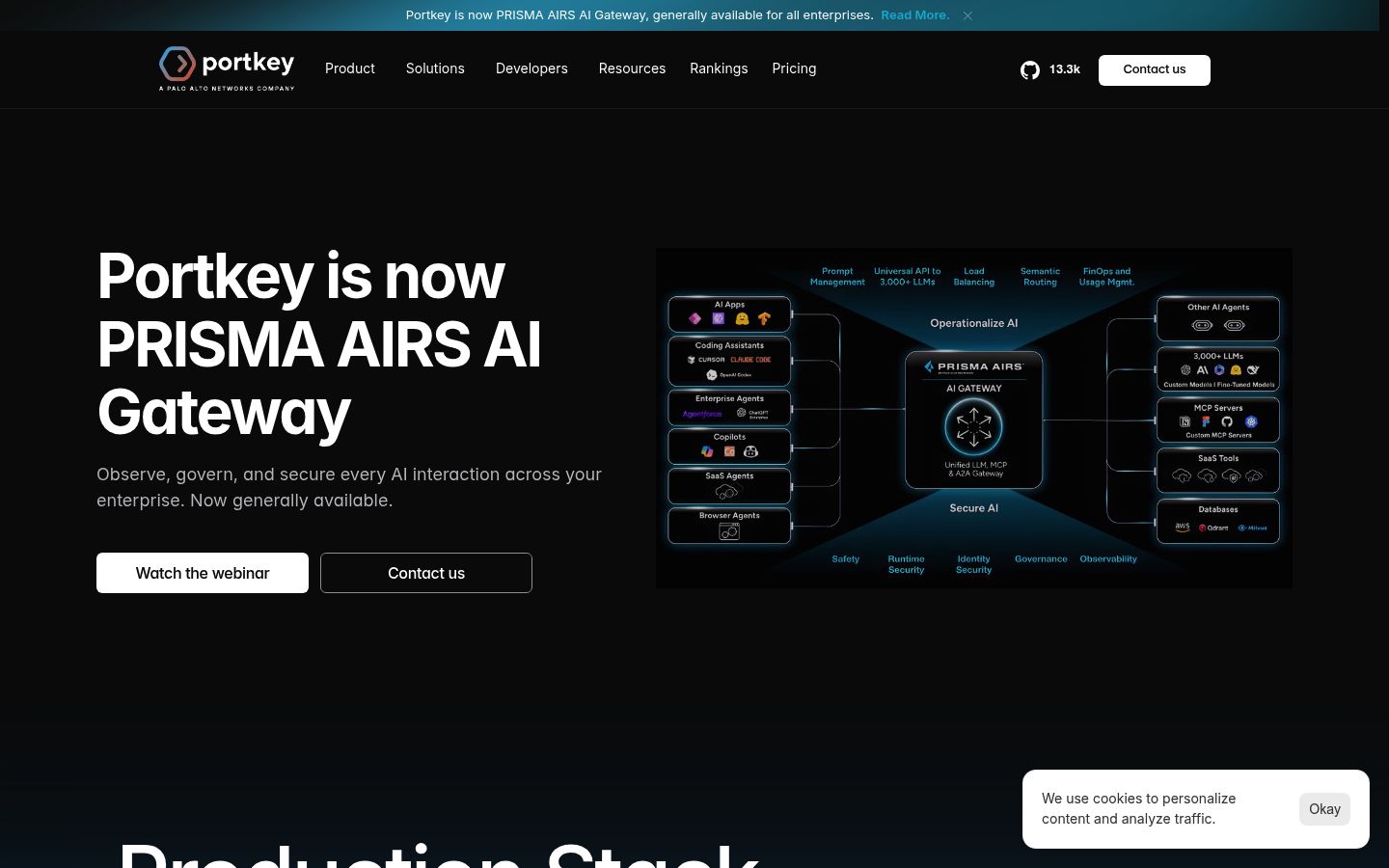
Portkey’s AI Gateway documentation documents a universal API, provider fallbacks, conditional routing, caching, rate limits, budget limits, custom hosts, and remote MCP support. It also documents an open-source gateway that teams can run locally and connect to Portkey.
Portkey fits an organization whose primary problem is consistent model access across providers. The procurement question is whether the same control depth reaches the MCP side of the architecture. A reliable model router is not automatically a least-privilege tool gateway.
Best for: AI platform teams that need provider routing, resilience, spend controls, and a common model access layer.
Limitation: the public gateway documentation gives more detail on LLM operations than on per-agent MCP discovery filtering, backend reachability, or tool-argument policy. Treat those controls as unproven until the vendor demonstrates them.
Pass test: run a remote MCP call beside a model call, then export logs that show the agent identity, tool decision, model request, destination, and result in one trace.
NetFoundry: the identity-first reachability option
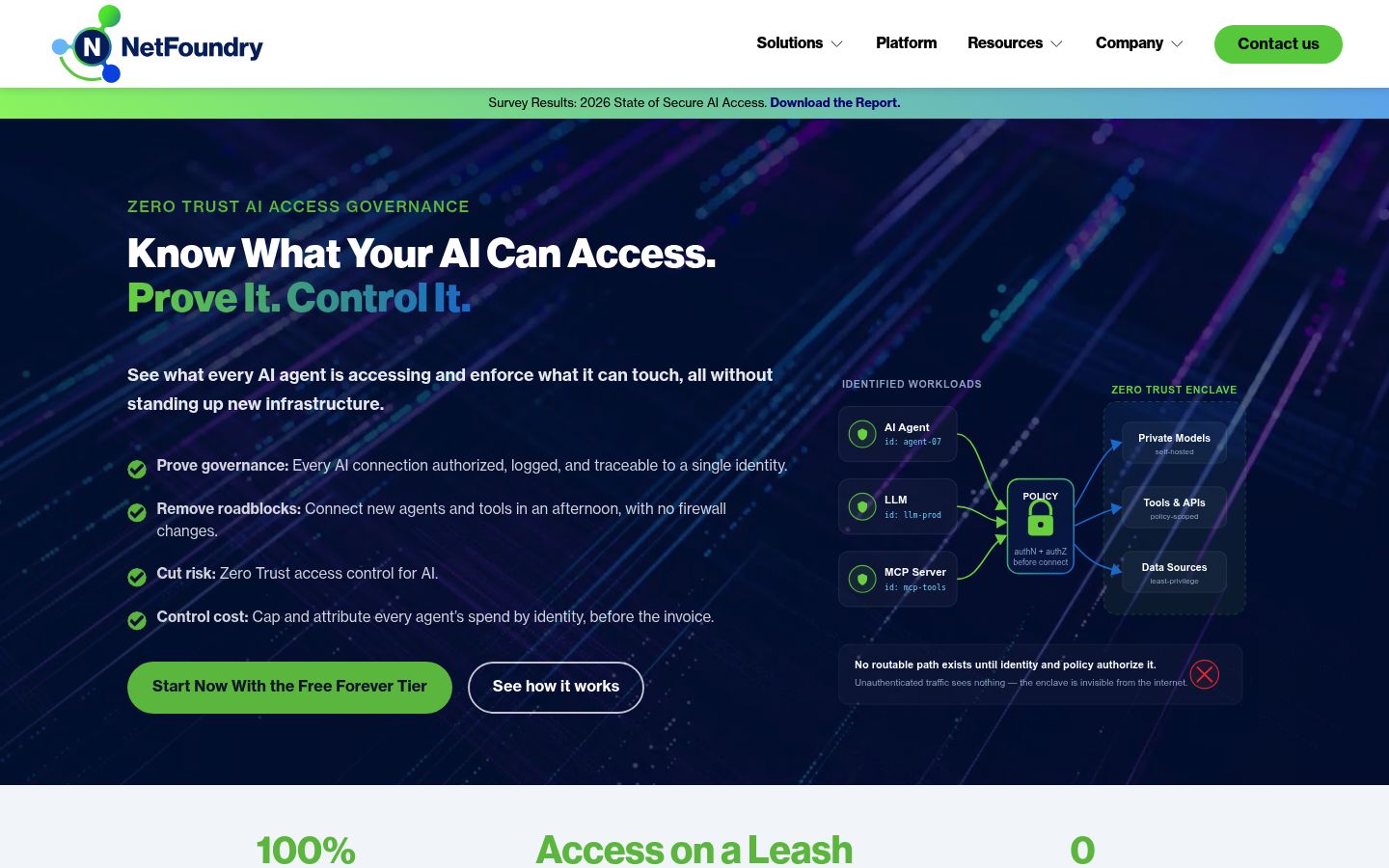
NetFoundry AI Security positions identity and reachability as the first control boundary. Its public material describes cryptographic identities for agents, MCP servers, and models, plus policy-based access across private and distributed infrastructure.
The product direction matches a CISO requirement that an unauthorized agent should not first connect and then receive a rejection. NetFoundry also connects the discussion to Non-Human Identity, microsegmentation, and Secure Workload Connectivity. OpenZiti is the open-source foundation referenced in the governance material.
Best for: enterprise security and infrastructure teams that need the same identity and service policy across AI components and private workloads, not just a gateway in front of a public endpoint.
Limitation: public pages do not provide a complete plan matrix or standard price. Confirm deployment boundaries, identity-provider integration, log export, policy administration, and support terms with the vendor.
Pass test: revoke one agent identity and show that it loses reachability to its MCP server and backend while other approved agents continue to work.
The two-agent proof of concept
A two-agent proof of concept gives you a repeatable pass-or-fail test across all three vendors.
Create a read-only research agent and an operator agent. Give the test MCP server a read tool and a write tool. Keep the data harmless but make the permissions real.
| Test | Read-only agent | Operator agent | Evidence to retain |
|---|---|---|---|
| Discovery | Sees the read tool only | Sees both tools | Tool lists before invocation |
| Invocation | Write call fails | Write call succeeds | Request, decision, and response |
| Identity | Unique identity | Different unique identity | Issuance and policy records |
| Revocation | Fails after expiry or revocation | Continues under its policy | Failed connection and control event |
| Isolation | Cannot reach an unapproved backend | Reaches only its approved backend | Reachability result and logs |
Do not accept a screen recording without raw evidence. The evidence package should include policy configuration, test inputs, tool lists, denied requests, identity records, exported logs, and the rollback procedure.
What to put in the vendor contract
Put the controls you tested into the contract and security exhibit. Name the identity model, supported deployment modes, log fields, retention, export format, incident support, and policy-change process.
Define the boundary between the gateway and the MCP server. The gateway should narrow reachability and enforce policy. The server should validate tokens for its own resource, refuse token passthrough, limit backend authority, validate tool arguments, and record security events.
Ask for a current feature matrix by edition. Mark every item as documented, demonstrated, contractually committed, or unverified. Do not convert a roadmap statement into an acceptance criterion.
Bottom line: score evidence, not labels
Choose Kong when your API gateway estate is the main constraint and its MCP controls pass the two-agent test. Choose Portkey when model routing, provider failover, budgets, and LLM observability lead the decision, then test the depth of its MCP controls. Choose NetFoundry when identity-first reachability and cross-workload isolation are the deciding requirements.
No vendor should pass on the phrase “AI security” alone. A production decision needs a distinct workload identity, least-privilege tool policy, correlated telemetry, tested containment, and an operating model your security team can own.
FAQ
What is a vendor security assessment for an MCP gateway?
A vendor security assessment checks whether an MCP gateway can identify agents, control tool discovery and invocation, protect backend services, produce audit evidence, and support revocation. It should include a live failure test, not only a questionnaire or feature list. The evidence should be repeatable by your own team.
How should a CISO evaluate an LLM gateway?
A CISO should test provider credential custody, model and data policy, budgets, routing, logging, deployment boundaries, and incident response. When the gateway also handles MCP, add tool discovery, per-agent authorization, backend isolation, and token audience tests. Require raw evidence for both allowed and denied requests.
Is an API gateway enough to secure MCP servers?
An API gateway can provide authentication, rate limits, quotas, monitoring, and traffic policy. It is enough only when it also enforces the tool and identity controls your use case requires, and when the MCP server validates its own tokens and backend permissions. Test both layers before approval.
What evidence should a security vendor provide?
Request architecture and deployment documentation, identity issuance and revocation records, policy configuration, raw logs, data handling terms, support boundaries, and a proof-of-concept export. The vendor should show both an allowed action and a denied action using different agent identities. Ask for the exact edition and deployment model tested.
Can an MCP gateway stop prompt injection?
An MCP gateway can reduce the impact of prompt injection by limiting tool discovery and invocation. It cannot determine whether every model instruction is safe, so the application still needs input validation, backend authorization, approval controls, and monitoring. Keep those responsibilities explicit in the architecture and contract.
What is the difference between MCP authorization and tool authorization?
MCP authorization protects the protocol connection and validates that a token is intended for the MCP resource. Tool authorization decides which named operation an identified agent may discover and invoke, under which context and with which arguments. A secure design needs both controls at separate decision points.
Sources & References
- MCP Authorization Specification: token audience and resource rules
- NIST AI Risk Management Framework: AI risk governance
- NIST Zero Trust Architecture: identity before access
- OWASP AI Agent Security Cheat Sheet: agent security controls
- Kong AI Gateway: documented LLM and MCP controls
- Portkey AI Gateway documentation: routing and remote MCP controls
- NetFoundry AI Security: identity-first reachability