
Make APIs Invisible. Until Access Is Authorized.
Reduce your internet-facing API attack surface by 99.99%. APIs remain completely unreachable until authentication and authorization are complete — no open ports, no potential vulnerabilities for an attacker to exploit.
The Fundamental Problem Is Reachability
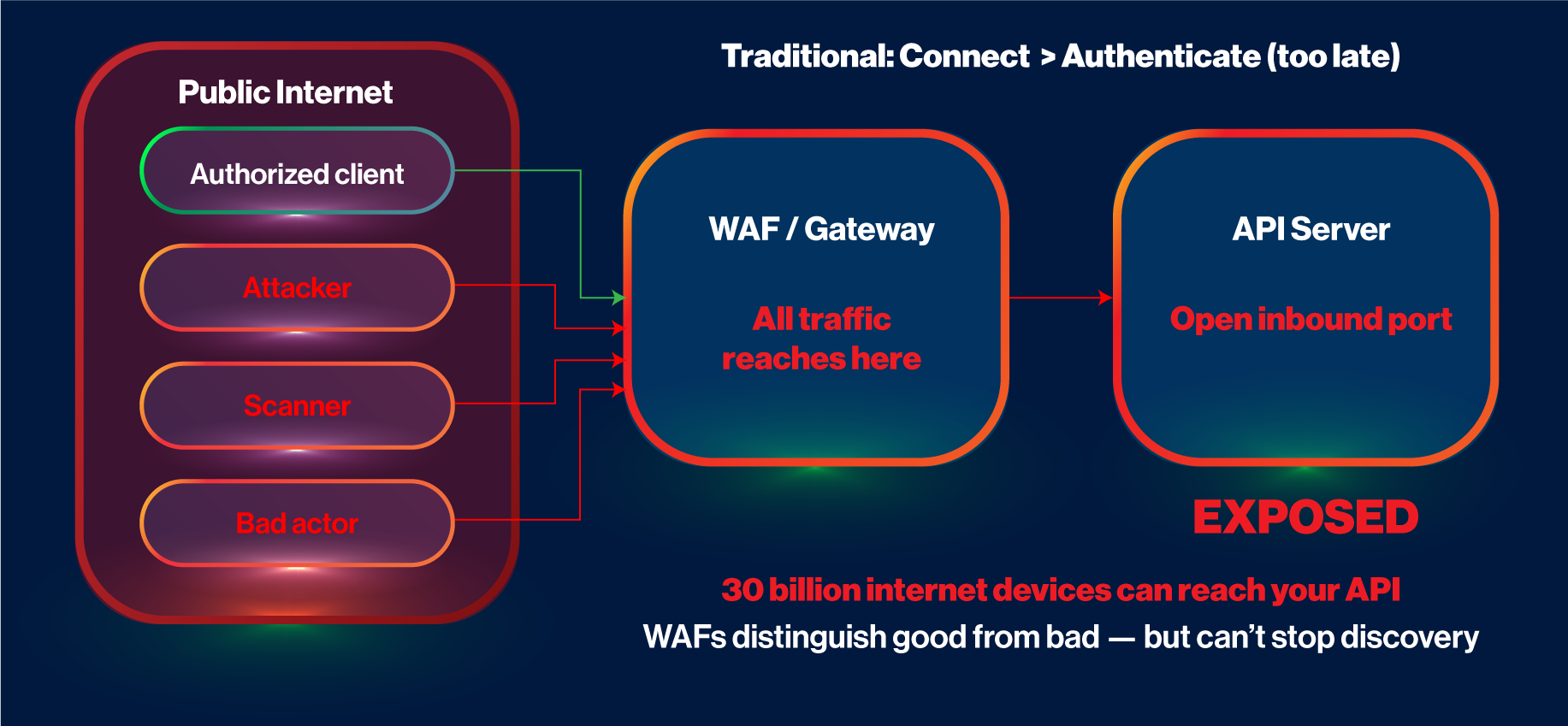
Traditional API security — WAFs, API gateways, rate limiting — all filter inbound traffic. But with 30 billion internet-connected devices able to reach your API infrastructure and vulnerabilities being the primary attack vector, no amount of traffic inspection stops an exploit targeting the API itself.
- WAFs can’t reliably distinguish legitimate inbound connections from malicious ones
- API gateways process traffic that has already reached your infrastructure
- Open inbound ports are visible and scannable by every automated attack tool on the internet
- IP-based trust models grant network reachability before any authentication occurs
- Shared credentials and API keys create sprawling, hard-to-rotate secret management
- No identity associated with connections — traffic visibility by IP address, not identity
Eliminate Reachability Before Authentication
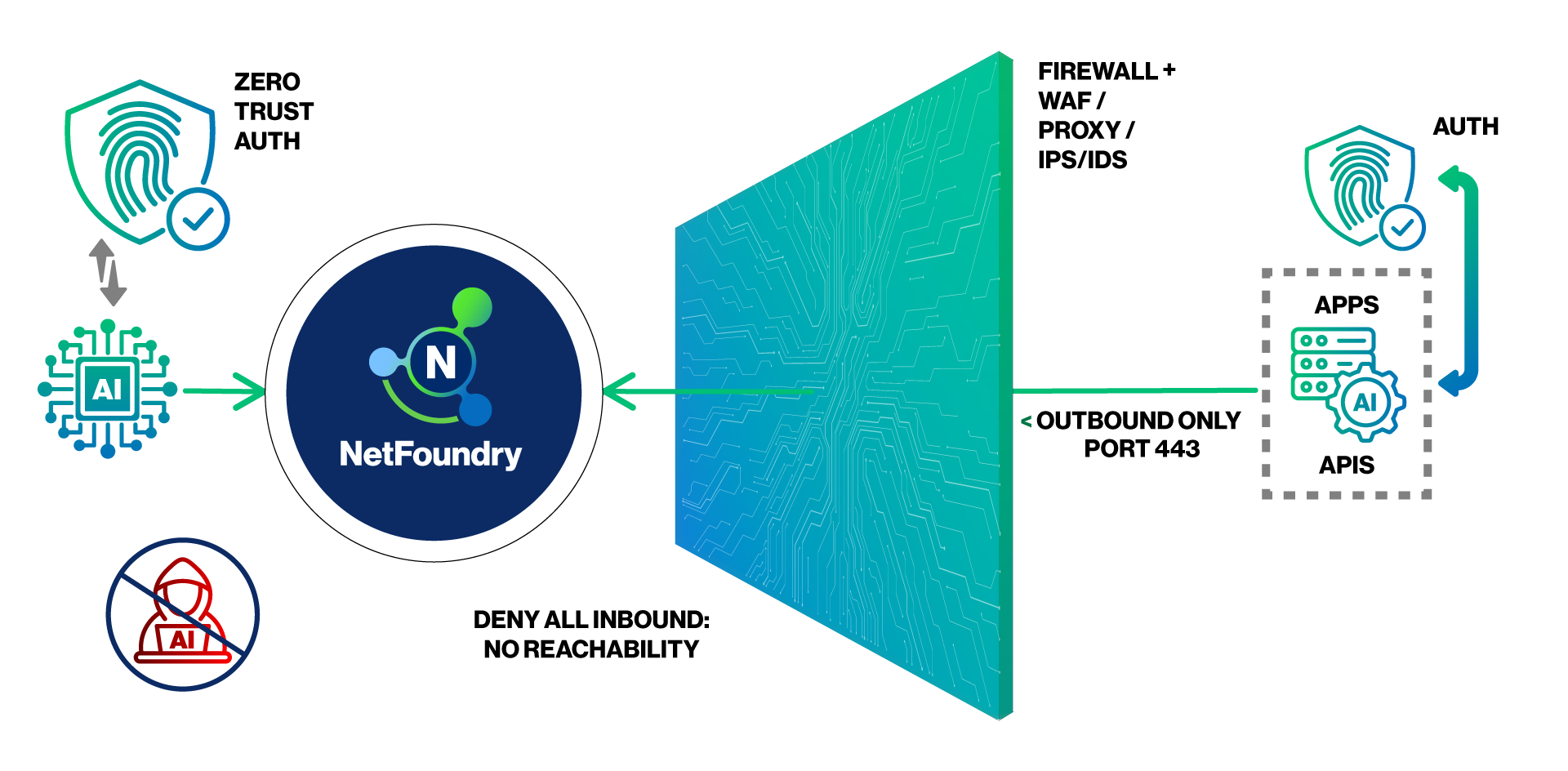
NetFoundry’s Identity-First Reachability™ makes APIs invisible to unauthenticated actors. There are no open ports for scanners to discover, and no way for attackers to discover and exploit vulnerabilities. APIs simply don’t exist to anyone who hasn’t first authenticated and been authorized.
The only way to truly eliminate your API attack surface
Traditional approaches process inbound traffic and try to filter malicious requests. NetFoundry eliminates the attack vector entirely — by ensuring unauthenticated actors never reach your APIs in the first place. You can’t exploit what you can’t reach.
- APIs are completely invisible and unreachable until identity verification is complete
- Outbound-only connections from API servers — no inbound ports, ever
- Service-level least privilege — each client identity can only reach the specific services it is authorized for
- Agent and agentless deployment options — embed directly in your application or deploy alongside it
- Secure APIs without API gateways and block lateral movement
- Identity-based observability — see which identity is calling which API, not just which IP
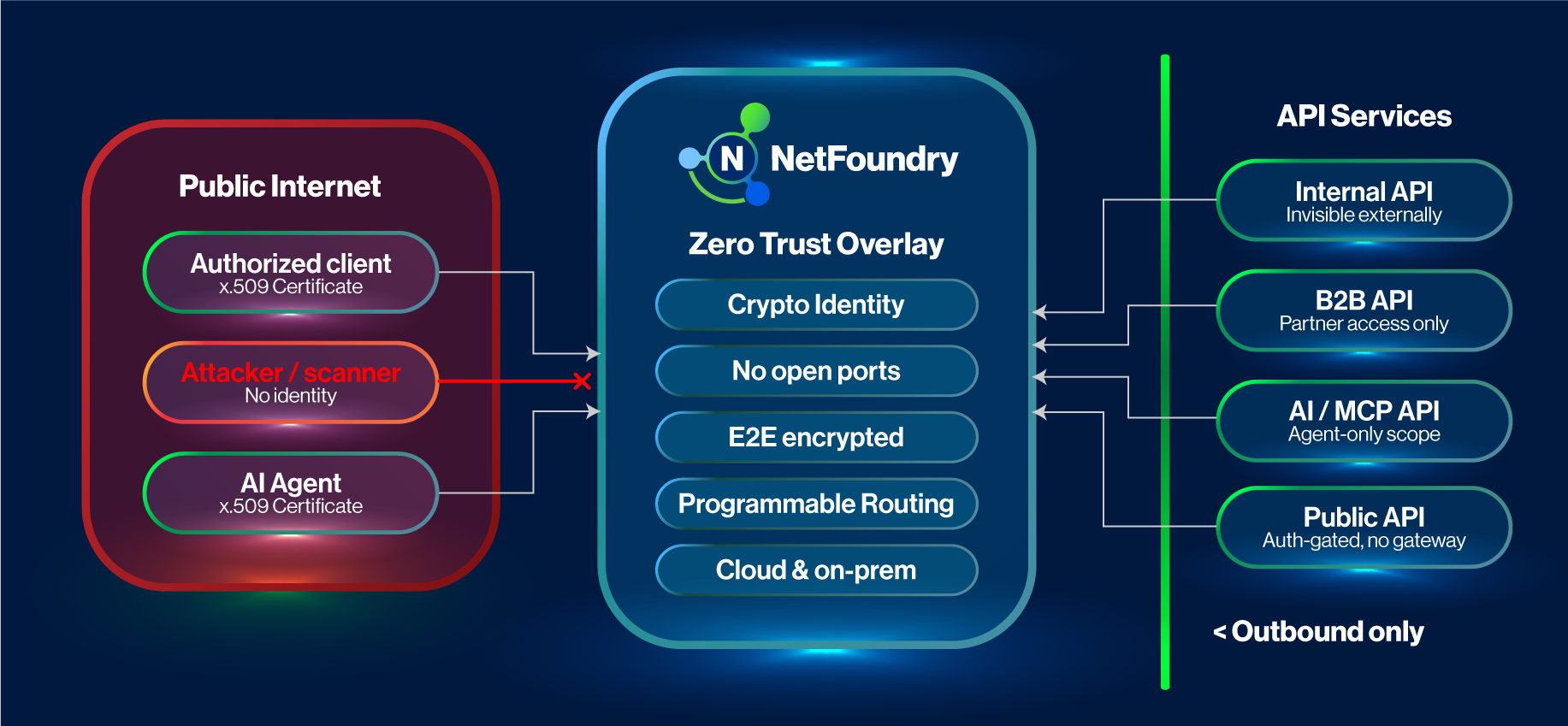
Every Type of API, Fully Protected
Partner and third-party API access
Replace VPNs and IP allowlists for partner connectivity. Each partner identity gets a certificate — least-privilege access to only the services they need, with full auditability of every call.
API access for AI agents and MCP servers
Eliminate API Keys and potential for credential theft. Agents can only discover and call APIs within their policy scope — and you can track every token of usage by identity.
Microsegmentation of internal services
Block lateral movement through your internal API landscape. Define access by identity and service — not IP address or network segment — for true least-privilege internal connectivity.
Secure public API publishing without a gateway
The only approach that lets you publish APIs for public use without an API gateway while simultaneously blocking lateral movement and making infrastructure invisible to scanners.
Provider-to-customer connectivity
Software and SaaS providers connecting into customer environments can do so without requiring customers to open inbound ports or deploy VPNs — accelerating deployments and security reviews.
APIs in industrial and edge environments
Extend identity-first API security to OT, IoT, and edge devices. No VLAN changes, no firewall rule modifications — outbound-only connectivity from any environment, at any scale.
NetFoundry vs. Traditional API Security
| Security capability | WAF / API Gateway | NetFoundry Identity-First |
|---|---|---|
| Can unauthenticated actors discover your APIs? | Yes — open ports are visible and scannable | No — APIs are completely invisible |
| Attack surface reduction | Reduces exploitability; does not reduce discovery | Up to 99.99% — no open inbound ports |
| Identity associated with connections | Typically IP-based; JWT tokens post-connection | Certificate identity verified before any connection |
| Lateral movement prevention | Limited; requires additional network segmentation | Built-in — service-level least privilege by identity |
| Traffic to analyze | All internet traffic — high volume, high noise | Authorized traffic only — dramatically reduced volume |
| Operational overhead | Ongoing rule management, tuning, false positives | Centralized identity-based policy — minimal ongoing changes |
“NetFoundry’s Zero Trust B2B met our customer’s most stringent security requirements — no permitted IP addresses in their firewalls and no S2S VPNs.”
John Wilson, CEO — TZ Limited
“NetFoundry’s Zero Trust B2B solution has significantly enhanced the security and performance of our integration platform, allowing us to deliver reliable and secure services to our customers without S2S VPN and firewall headaches.”
Rodrigo Bernardinelli, Co-Founder — Digibee
What You Gain with Zero Trust API Security
Reduce exploitation risk
Since there are no inbounds ports or internet-facing elements, there’s no path for an attacker to take advantage of known or unknown vulnerabilities.
Identity-based observability
See exactly which identity is calling which API — not just which IP address. Simplified governance, faster incident response, and cleaner audit trails.
Eliminate credential sprawl
Reduce shared secrets, the headaches rotating them and the risk of their being hijacked. Certificate-based machine identities are bound to specific workloads and can’t be reused by an attacker.
Lower operational overhead
No WAF rule tuning, no false positive triage, no IP allowlist maintenance. Identity-based policy managed centrally — changes take effect instantly across all environments.
Simplified compliance
Supports HIPAA, PCI-DSS, SOC 2, EU CRA, NIS-2, and FIPS environments. Immutable identity-based logs provide clear evidence for assessments and audits.
Works with your stack
Lightweight SDKs in C, Go, Java, Python, and more. Deploy as standalone binaries or containers. Embed zero trust directly into your application — no hardware firewalls required.
Frequently Asked Questions
What is Zero Trust API security?
NetFoundry delivers Zero Trust API security by keeping every API unreachable until it authenticates and authorizes the calling identity. Each API connects outbound-only through an identity-based overlay, opens no inbound listening ports, and stays invisible to unauthorized clients and internet scans. This removes the exposed attack surface that perimeter defenses leave in place.
How does NetFoundry secure APIs and prevent exposure?
NetFoundry secures APIs by binding a certificate-based identity to every service and client and enforcing policy before it establishes any connection. Because APIs dial outbound to the overlay instead of listening for inbound traffic, no public endpoint exists for an attacker to discover, probe, or exploit. Authorized callers reach the API over a mutually authenticated conduit, and everyone else sees nothing.
Why aren’t API gateways and web application firewalls enough?
NetFoundry closes a gap that API gateways and web application firewalls leave open: those tools filter traffic to an endpoint that still has to be publicly reachable to work. An exposed endpoint can be scanned, fingerprinted, and attacked even when a gateway sits in front of it. NetFoundry removes the reachability itself, so the endpoint is never exposed to unauthorized clients in the first place.
Does NetFoundry require opening inbound ports or changing firewall rules?
NetFoundry requires no inbound ports and no inbound firewall changes. APIs and their clients establish only outbound, mutually authenticated connections to the identity-based overlay, which makes inbound firewall rules and public DNS entries for the API unnecessary. Security and network teams gain protection without widening the perimeter or managing new inbound exposure.
How does NetFoundry help against AI-accelerated vulnerability discovery?
NetFoundry undercuts AI-accelerated vulnerability discovery by removing the exposed surface those tools depend on. Attackers increasingly use AI to find and exploit reachable API endpoints faster than teams can patch them, but an API that opens no inbound ports and stays invisible gives automated tooling nothing to enumerate. Identity and policy decide who can connect, rather than how quickly a weakness surfaces.
What types of APIs can NetFoundry protect?
NetFoundry protects internal, partner, and public-facing APIs, along with the machine-to-machine and service-to-service calls that connect applications, agents, and workloads. The same identity-first overlay spans data centers, clouds, and edge environments, giving every API the same outbound-only, policy-enforced connectivity. One model then covers API traffic that would otherwise rely on a mix of gateways, VPNs, and network controls.
Eliminate Your API Attack Surface
See how NetFoundry makes APIs invisible to unauthorized actors — with a live demo built around your specific API security use case.